

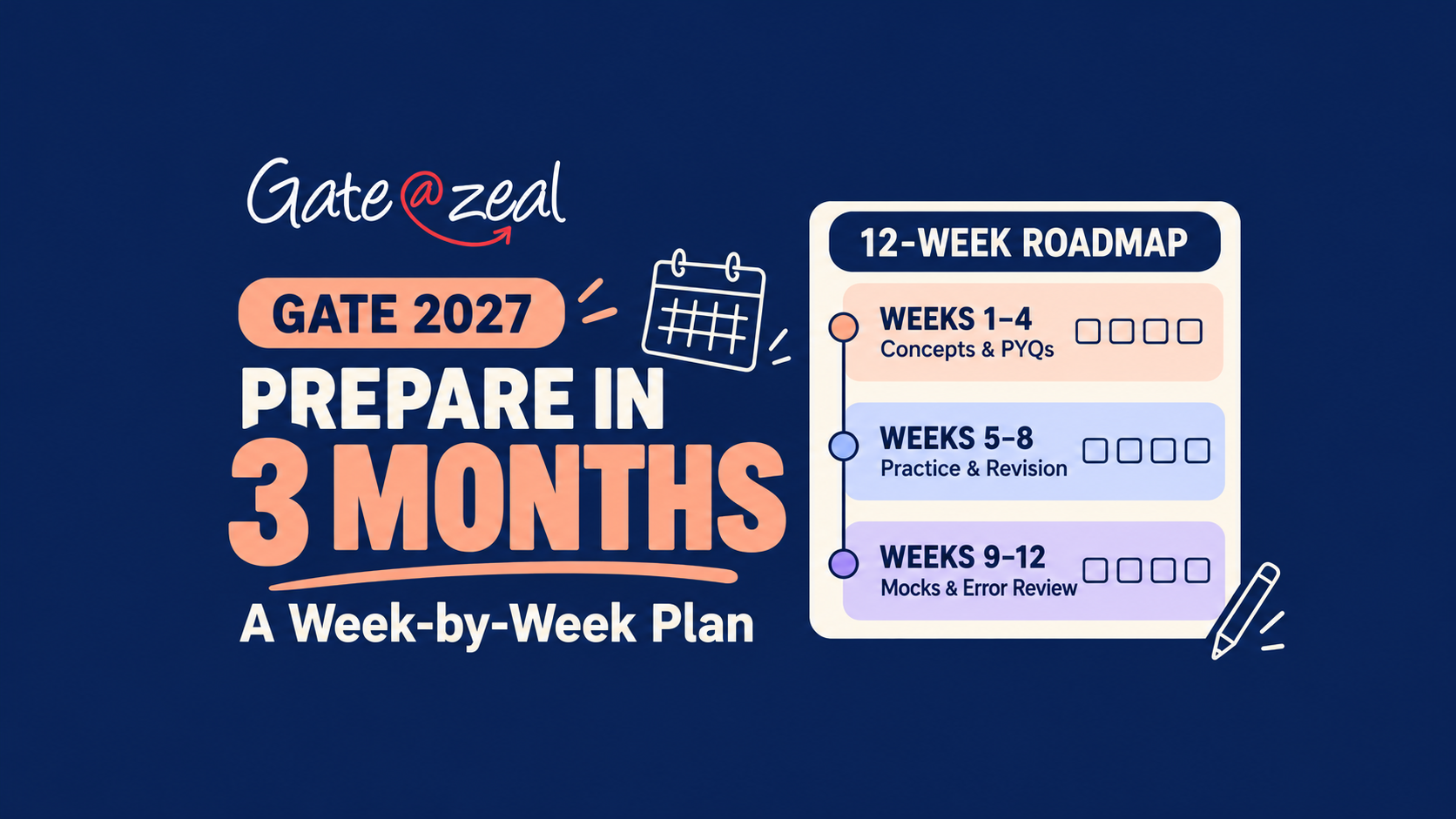
Yes, you can prepare for GATE in 3 months if you study with a plan, cut what does not earn marks and practise under exam conditions every week. Three months will not make every topic perfect. It can make you strong in the topics that carry the most marks, sharp in General Aptitude and calm with the exam format.
The timing fits GATE 2027 almost exactly. From 2 November 2026, the first exam day, 6 February 2027, is 96 days away. The exam runs on 6, 7, 13, 14, 20 and 21 February 2027, per the official important dates page, and the paper-wise schedule is not out yet. Plan for 6 February; any later date is a bonus.
The 3-month plan at a glance
| Phase | Dates | Main job |
|---|---|---|
| Month 1: Build | 2 Nov to 30 Nov | Cover high-weight topics, past questions topic-wise, GA daily |
| Month 2: Strengthen | 1 Dec to 31 Dec | Finish the syllabus you will attempt, weekly full papers, first revision |
| Month 3: Perform | 1 Jan to your exam | Two full papers a week, error-log revision, official mock, exam routine |
This guide from Gate At Zeal Indore shows how to prepare for GATE in 3 months, week by week, with a daily timetable, a subject priority method and the exact rules of the GATE 2027 paper.
Step 1: Know where you stand
The same three months look very different depending on what you already know. Spend one day honestly placing yourself in one of these groups.
| Starting point | Typical situation | Your 3-month focus |
|---|---|---|
| A. Fresh start | Little or no GATE study yet | Pick the highest-weight subjects you can finish; skip some low-yield topics |
| B. Half done | Studied some subjects, no revision, few full papers | Close gaps in core subjects, then shift early to timed papers |
| C. Syllabus mostly done | Covered most subjects but scores feel stuck | Revision, timed papers, error analysis and speed |
A quick self-test
Take one full past GATE paper from the official GATE 2027 download page, timed, in the first week. Do not worry about the score. Use it to see:
- which subjects you could not attempt at all,
- which ones you attempted but got wrong,
- how much time General Aptitude took.
That single paper tells you more about your plan than any list of topics. Gate At Zeal Indore suggests starting every short plan with this kind of test, so the first month goes where it is needed.
Also Read: How to Score 80+ in GATE CSE: A Topper’s Strategy for GATE 2027

Set a realistic target
In three months, aim to be strong in the subjects that carry most of the marks and in General Aptitude, rather than average in everything. A focused GATE 2027 attempt beats a thin one spread across every topic.
Step 2: Know the GATE 2027 exam you are preparing for
A short plan has no room for surprises on exam day. These are the official rules from the GATE 2027 question paper pattern and information brochure.
| Feature | GATE 2027 |
|---|---|
| Duration | 3 hours |
| Questions | 65 |
| Total marks | 100 |
| General Aptitude (GA) | 15 marks, common to all papers |
| Question types | MCQ, MSQ and NAT |
| Mode | Computer-based, with an on-screen virtual calculator |
| Sessions | Forenoon 9:30 AM to 12:30 PM, afternoon 2:30 PM to 5:30 PM |
Marking rules that shape your strategy
| Question type | Right | Wrong |
|---|---|---|
| 1-mark MCQ | +1 | −1/3 |
| 2-mark MCQ | +2 | −2/3 |
| MSQ | Full marks only if fully correct | 0, no partial marks |
| NAT | Full marks | 0 |
Two things follow from this:
- MSQ and NAT have no negative marking, so never leave them blank if you have a reasonable answer.
- Blind guessing on MCQs does not pay on average. Guess only after you can rule out options with real reasoning.
The syllabus has been revised
The official site says the GATE 2027 syllabi have been revised. Download your paper’s syllabus from the official papers and syllabus page before you plan a single week, and plan from that list, not from old notes. There is also a new paper this year, Robotics and Automation (RA).
Step 3: The 3-month plan, week by week
Here is the full plan to prepare for GATE in 3 months, set against the GATE 2027 calendar. Adjust subject names to your own paper.
Month 1: Build (2 to 30 November)
Goal: cover the high-weight subjects you will attempt, learn how GATE asks them, and start GA early.
| Week | Dates | Focus |
|---|---|---|
| 1 | 2 to 8 Nov | Self-test paper, plan, start subject 1 and Engineering Mathematics basics |
| 2 | 9 to 15 Nov | Finish subject 1; past questions on it; start subject 2 |
| 3 | 16 to 22 Nov | Subject 2 and 3; one timed past paper on Sunday |
| 4 | 23 to 30 Nov | Subject 4; first quick revision of subjects 1 to 3 |
Every day in month 1: 30 to 45 minutes of General Aptitude, and past GATE questions on each topic as soon as you finish it.
Month 2: Strengthen (1 to 31 December)
Goal: finish the syllabus you will attempt, start weekly full papers and the first full revision.
| Week | Dates | Focus |
|---|---|---|
| 5 | 1 to 7 Dec | Remaining subjects; one full timed paper |
| 6 | 8 to 14 Dec | Remaining subjects; one full timed paper with full review |
| 7 | 15 to 21 Dec | Close the syllabus; revision round 1 for month-1 subjects |
| 8 | 22 to 31 Dec | Revision round 1 for the rest; one or two full timed papers |
By 31 December, stop starting new large topics. Anything still untouched is a skip-or-light decision, not a January project.
Month 3: Perform (1 January to your exam)
Goal: turn knowledge into marks under time pressure.
| Week | Dates | Focus |
|---|---|---|
| 9 | 1 to 10 Jan | Two full papers a week; error-log revision; check your exam city on 4 Jan |
| 10 | 11 to 17 Jan | Two full papers; revision round 2; official mock if live |
| 11 | 18 to 24 Jan | Two full papers at your session time; formula sheet revision |
| 12 | 25 to 31 Jan | Most recent past papers as full rehearsals; error log only |
| Last days | 1 to 5 Feb | Light revision, one short timed set, sleep and admit card check |
If your paper is on a later exam day, keep the month-3 rhythm going until a week before your date, then follow the last-days routine.
Rule for all three months: review every full paper before you take the next one. A paper you do not review only shows a score; it does not raise one.
Step 4: A daily and weekly timetable
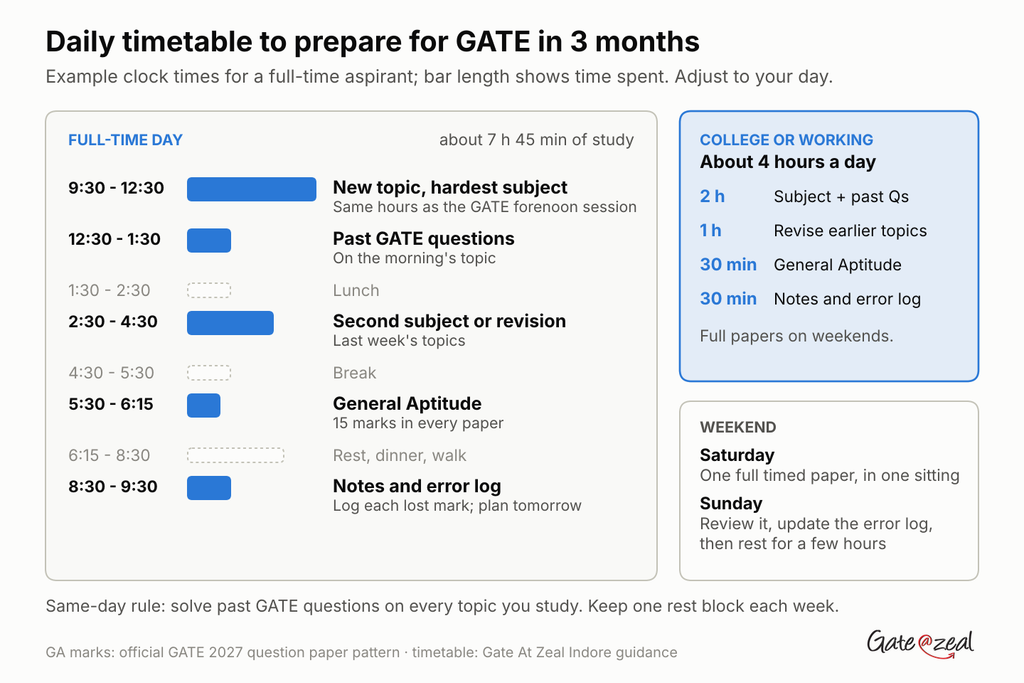
Three months of preparation is about 13 weeks of steady days, not a few long nights. These timetables assume about 8 hours of study for a full-time aspirant; scale them down if you are in college or working.
Daily timetable (full-time)
| Time block | Activity |
|---|---|
| Morning, 3 hours | New topic or hardest subject, when your mind is fresh |
| Late morning, 1 hour | Past GATE questions on the morning’s topic |
| Afternoon, 2 hours | Second subject or revision of last week’s topic |
| Evening, 45 minutes | General Aptitude practice |
| Night, 1 hour | Update short notes and error log; plan tomorrow |
Keep one block at the same time as your expected exam session (9:30 AM to 12:30 PM or 2:30 PM to 5:30 PM) for problem solving, so your brain is used to working hard at that hour.
For college students or working aspirants (4 hours a day)
| Time block | Activity |
|---|---|
| 2 hours | One subject, concept plus past questions |
| 1 hour | Revision of earlier topics |
| 30 minutes | General Aptitude |
| 30 minutes | Notes and error log |
Use weekends for full timed papers and their review. With less time each day, cutting low-yield topics matters even more.
Weekly rhythm
- Monday to Friday: subjects and topic-wise past questions.
- Saturday: full timed paper (from week 3), in one sitting.
- Sunday: review the paper, update the error log, revise the week’s notes, and rest for a few hours.
One rest block each week is part of the plan, not a break from it. Three months is long enough for burnout to cost more marks than one evening off.
Also Read: GATE 2027 Branch Wise Exam Schedule: Paper Wise Dates and Sessions
Step 5: Decide which subjects come first
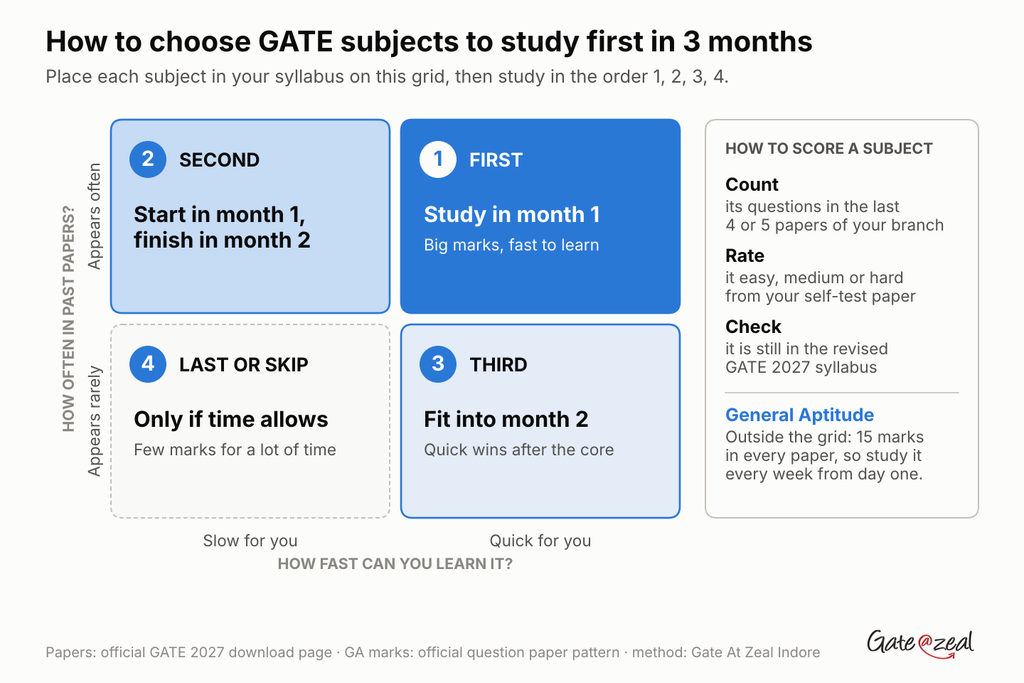
With 96 days, the order you study in decides your score. Use a simple two-question test for each subject in your GATE 2027 syllabus.
- How often does it appear? Count its questions in the last four or five GATE papers for your branch, using the official papers and answer keys.
- How fast can you learn it? Rate it easy, medium or hard for you, based on your self-test and college background.
Then sort:
| Appears often | Quick for you | Priority |
|---|---|---|
| Yes | Yes | First. Study in month 1 |
| Yes | No | Second. Start in month 1, finish in month 2 |
| No | Yes | Third. Fit into month 2 |
| No | No | Last or skip. Only if time allows |
General Aptitude sits outside this table. At 15 marks in every paper and with a short syllabus, it belongs in every week from day one.
Example: GATE 2027 CSE in 3 months
The GATE 2027 Computer Science syllabus has ten sections, from Engineering Mathematics to Computer Networks: Engineering Mathematics, Digital Logic, Computer Organization and Architecture, Programming and Data Structures, Algorithms, Theory of Computation, Compiler Design, Operating System, Databases and Computer Networks.
A practical order that Gate At Zeal Indore suggests for a 3-month CSE plan, to be checked against your own past-paper count:
- Month 1: Engineering Mathematics (discrete maths, linear algebra, probability), Programming and Data Structures, Algorithms, and the start of Operating System.
- Month 2: Operating System, Databases, Computer Networks, Theory of Computation, Computer Organization and Architecture.
- Late month 2 or month 3, lighter: Digital Logic and Compiler Design, which many students find quicker to revise once the core is done.
Check every topic against the revised GATE 2027 CS syllabus before you start it. If a topic has been removed, drop it; if one has been added, it has no past questions, so practise it from your study material.
For other branches
The same method works for EC, EE, ME, CE, IN, DA and the rest. Engineering Mathematics and General Aptitude are worth early attention in every branch, because they are part of most papers and reward steady practice.
Step 6: Previous year papers and mock tests
In a 3-month plan, practice is not something you do after the syllabus. It runs alongside it from week one.
Previous year papers
The official GATE 2027 download page offers a bulk download of question papers from 2007 to 2026, and year-wise papers with official answer keys from 2021 to 2026, free.
| When | How to use them |
|---|---|
| Month 1 | Topic-wise: after each topic, solve every past question on it |
| Month 2 | Year-wise: one full timed paper a week, older years first |
| Month 3 | The most recent years as full rehearsals, two a week with mocks |
Keep the two or three most recent years untouched until January. They are the closest thing to a real GATE 2027 paper you will have. Check every old question against the revised syllabus before relying on it.
Our detailed guide on GATE previous year question papers covers the three-pass method and self-scoring.
Mock tests
- Full-length mocks: add fresh questions beyond past papers. Take them weekly from December and twice a week in January.
- Official GATE mock: shows the real exam screen and virtual calculator. Use it as soon as it is live on the official site, and again close to the exam. Our GATE 2027 mock test guide explains how.
How many full papers in 3 months?
Following the plan above gives about 15 full timed papers between mid-November and early February, mixing past papers and mocks, each one reviewed. More papers without review add little; fewer with deep review often help more.
Step 7: A revision system that fits 3 months
When you prepare for GATE in 3 months, you cannot re-read full books in January. Build three small tools from the first week and revise from them.
1. Short notes
- One or two pages per topic, written after you finish it.
- Only what you would forget: key results, standard approaches, traps from past questions.
- Write them in your own words, not copied from a book.
2. Formula sheet
- One running sheet per subject for formulas, definitions and standard values.
- Read it for 15 minutes before sleep a few times a week.
- In the final week, this sheet is your main revision material.
3. Error log
After every past paper and mock, write each lost mark in a simple table:
| Question | Subject and topic | Type of mistake | Fix |
|---|---|---|---|
| Paper and number | e.g. OS, scheduling | Concept gap, calculation slip, misread, wrong guess or time-out | One line on what to do next time |
Group the log by mistake type each Sunday and fix the biggest group first. Our guide on how to analyse GATE CSE mock tests shows the method in detail.
Revision rounds
| Round | When | What |
|---|---|---|
| Quick revisions | End of each week | That week’s short notes |
| Round 1 | Mid to late December | All subjects from notes and formula sheet |
| Round 2 | Mid January | All subjects, plus every error-log entry |
| Final round | Last 5 to 7 days | Formula sheet and error log only |
Mistakes to avoid in a 3-month GATE plan
- Trying to cover everything. Ninety-six days rewards depth in the subjects that score, not a thin pass over all of them.
- Watching lectures without solving. Every hour of theory needs past questions the same day, or it fades by January.
- Leaving General Aptitude for the end. It is 15 marks in every paper and improves with steady daily practice.
- Starting full papers too late. Begin by week 3. Speed and stamina need several weeks to build.
- Taking papers without review. The score is the least useful part of a mock; the error log is the useful part.
- Ignoring the revised syllabus. Plan from the official GATE 2027 syllabus, not old notes or old topic lists.
- Guessing blindly on MCQs. Wrong MCQs cost 1/3 or 2/3 of a mark. Guess only when you can rule out options.
- Leaving MSQ and NAT blank. They carry no negative marks, so a reasoned attempt never costs marks.
- Changing the plan every week. Adjust on Sundays based on the error log, not every time a new resource appears.
- Skipping sleep before tests. Practise papers well-rested; exam day will ask the same of you.
- Saving the newest papers for nothing. Keep the most recent years for January, but do use them; they are your best rehearsal.
The last 10 days and exam day
Last 10 days
| Days before your exam | Plan |
|---|---|
| 10 to 6 | One full paper every other day at your session time; revise the error log |
| 5 to 2 | No new topics; formula sheet, short notes and one short timed GA set daily |
| 1 | Light revision only; pack the bag; sleep early |
The city allotment notification comes on 4 January 2027. The admit card date is still to be announced, as of 2 November 2026. When the admit card is out, it gives your date, session, centre and reporting time. Download it the first day, check every detail, and print it on A4, preferably in colour, as the brochure asks.
Exam day
- Carry: the printed admit card and the same original, valid photo ID you used in your application.
- Leave behind: mobile phones (even switched off), watches, calculators, wallets, papers and pen or pencil pouches. The brochure says candidates with prohibited items will be disqualified whether they use them or not.
- Inside: an on-screen virtual scientific calculator and a scribble pad are provided.
- Timing: you may be seated 40 minutes before the start and log in 20 minutes before; no login is allowed after 15 minutes past the start.
Inside the exam: a simple order
- Do General Aptitude first or last, but in a fixed time box you practised in mocks.
- First pass: attempt every question you are sure of.
- Second pass: MSQ and NAT you can reason through, since they carry no negative marks.
- Third pass: MCQs where you can rule out options; leave the rest.
- Keep five minutes to review marked questions.
Use the order that worked best in your mocks. Exam day is not the time to try a new one.
Frequently asked questions
Can I prepare for GATE in 3 months?
Yes, with a focused plan. Prioritise the subjects that appear most in past papers, practise General Aptitude daily, start full timed papers by the third week and review every paper. Three months will not cover every topic in depth, so choose wisely.
How many hours a day should I study to prepare for GATE in 3 months?
There is no official number. A full-time aspirant can plan around 8 focused hours a day; a college student or working aspirant can make about 4 hours a day work with a tighter subject list and weekend papers.
Which subjects should I study first for GATE 2027?
Start with subjects that appear often in past GATE papers for your branch and that you can learn quickly. Add General Aptitude from day one, since it carries 15 marks in every paper.
How many days are left for GATE 2027?
From 2 November 2026, the first GATE 2027 exam day, 6 February 2027, is 96 days away. The exam runs on 6, 7, 13, 14, 20 and 21 February 2027, and the paper-wise schedule is not announced yet.
Are previous year papers enough to prepare for GATE in 3 months?
They are the most important practice material, but not enough on their own. Combine them with concept study, full-length mocks and the official GATE mock, and check old questions against the revised GATE 2027 syllabus.
Should I skip some topics in a 3-month plan?
Often, yes. If a topic rarely appears in past papers and is slow for you to learn, it is reasonable to leave it until the core subjects and General Aptitude are strong.


