


If you’re searching for how to score 80+ in GATE CSE, you’re asking the right question. In recent CSE cycles, 80 raw marks out of 100 has sat roughly in the top 50 of the rank list, and it’s the gap between a strong GATE 2027 result and an exceptional one. The encouraging part is that the CSE paper is more predictable than it looks. Its 100 marks follow a fixed structure, its negative-marking rules are exact, and its topics are well documented in past papers.
Gate At Zeal Indore breaks down how a topper-level score is built, subject by subject, and what you can realistically do in the roughly four months left before the GATE 2027 exam window opens on 6 February 2027.
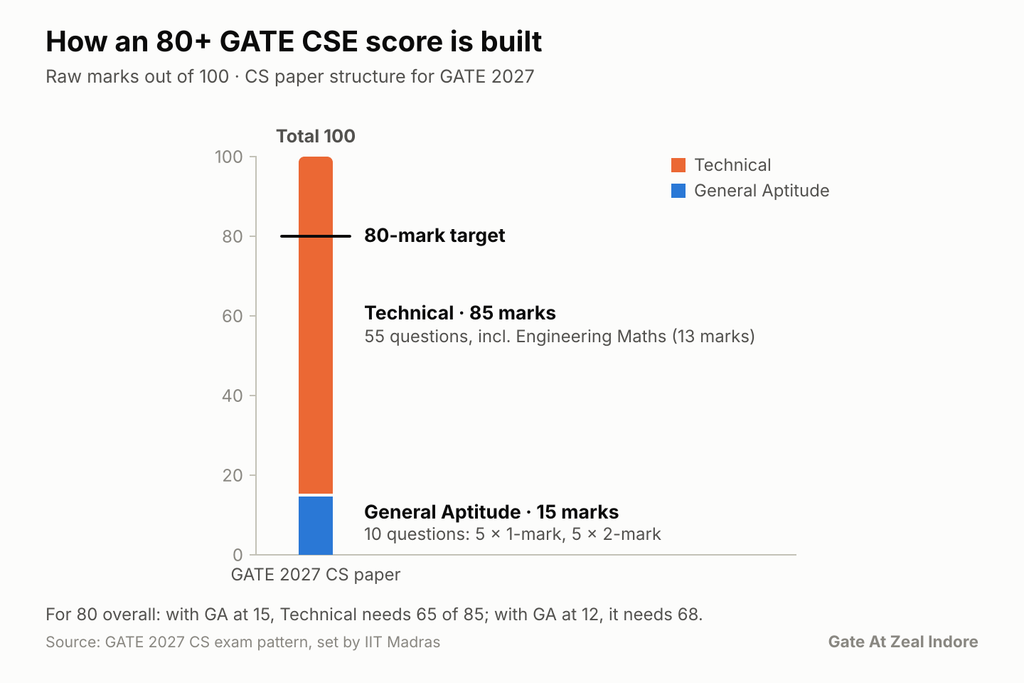
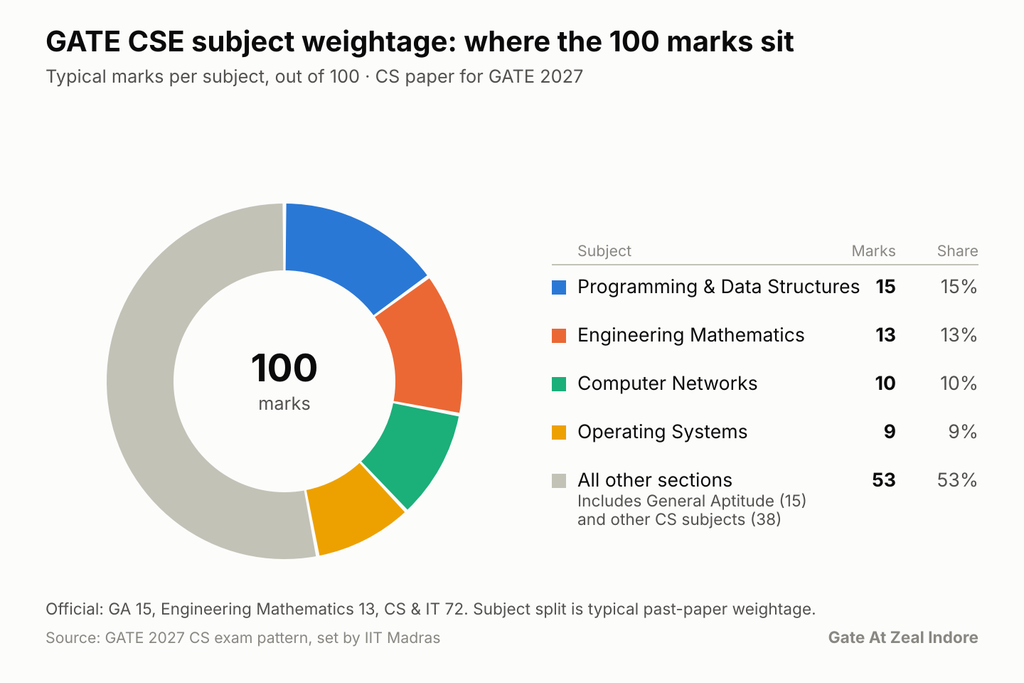
Quick answer: An 80+ score needs roughly 12 to 15 out of 15 in General Aptitude and 65 to 68 out of 85 in the technical section, which works out to about 76 to 80% accuracy on the technical paper with very few avoidable losses. The four biggest blocks are Programming & Data Structures (15 marks), Engineering Mathematics (13), Computer Networks (10) and Operating Systems (9). Negative marking is 1/3 for a wrong 1-mark MCQ and 2/3 for a wrong 2-mark MCQ, while MSQ and NAT questions carry none. Guess an MCQ only after eliminating at least one option.
Registration check: If you haven’t registered yet, act now. The official GATE 2027 site (gate2027.iitm.ac.in) says the regular registration window has closed and late-fee registration is open until 12 October 2026. Confirm the dates on the official portal before you pay.
What “80+” Actually Means in GATE CSE
Your raw marks are out of 100, and they’re the part of the score you control. The GATE score (out of 1000) is normalised across sessions, and ranks and admissions are based on that normalised figure. A raw score of 80 doesn’t translate into a GATE score of 800, because the conversion depends on how hard that year’s paper was and how the candidate pool performed.
| Raw marks (out of 100) | Approximate rank band (recent-cycle estimates) |
|---|---|
| 85 and above | Roughly top 10 |
| 80 to 84 | Roughly top 50 |
| 70 to 79 | Roughly top 50 to 200 |
| 60 to 69 | Roughly top 200 to 800 |
Those bands also explain why 80 is a stretch target rather than a comfortable one. If you’re thinking about IIT M.Tech seats or PSU cutoffs, the GATE score you need is a separate question, and our GATE cutoff trends guide covers it branch by branch.
The GATE 2027 CSE Paper: What You’re Actually Solving
The official GATE 2027 information brochure sets the basics. The paper runs for 3 hours, has 65 questions worth 100 marks, and uses MCQ, MSQ and NAT question types. General Aptitude is 10 questions worth 15 marks, split evenly between 1-mark and 2-mark questions. The remaining 55 technical questions carry 85 marks, including 13 marks from Engineering Mathematics.
| Section | Questions | Marks | Structure |
|---|---|---|---|
| General Aptitude | 10 | 15 | 5 × 1-mark, 5 × 2-mark |
| Technical | 55 | 85 | Engineering Mathematics 13 marks, CS subjects 72 marks |
| Total | 65 | 100 | 3 hours |
The official GATE 2026 CS paper followed this structure, with 30 one-mark and 35 two-mark questions across the whole paper. Use that split when you plan your pacing.
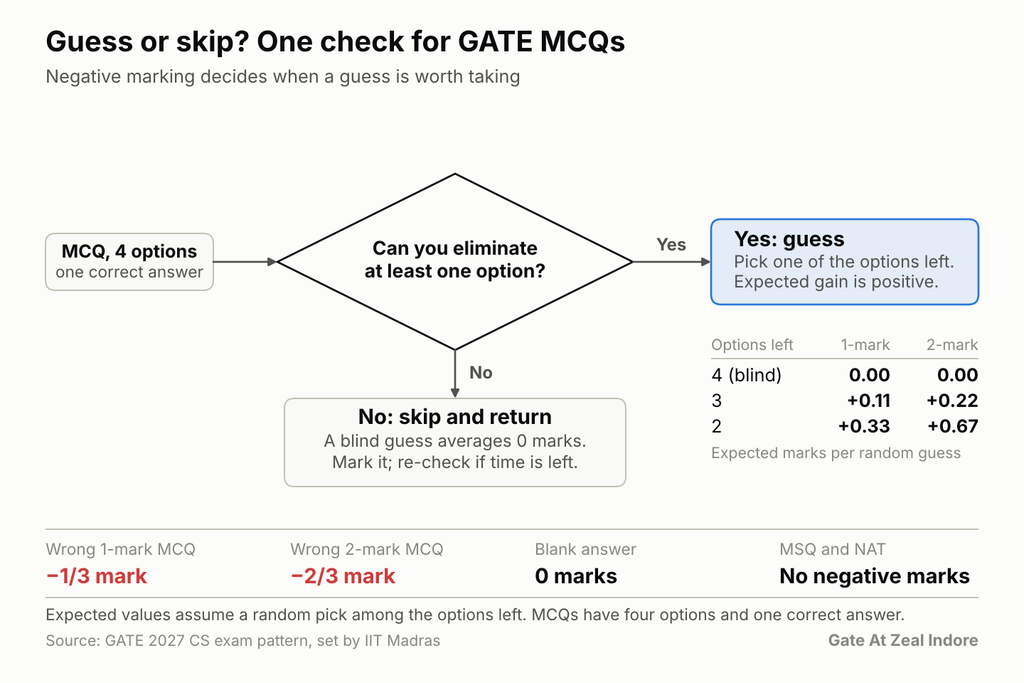
Negative marking works as follows. A wrong answer to a 1-mark MCQ costs 1/3 of a mark, and a wrong answer to a 2-mark MCQ costs 2/3 of a mark. There is no negative marking for MSQ or NAT questions. The brochure also states there is no partial marking for any question, so an MSQ earns credit only when the full answer is correct.

How the Paper Felt in 2026
Gate At Zeal’s analysis of the GATE CS 2026 paper rated it moderate to difficult and tougher than 2025. The hardest questions rewarded multi-step reasoning rather than recall. They included a non-standard dynamic programming question and a modified Dijkstra condition in Algorithms, a probability problem that combined ideas with combinatorics in Engineering Mathematics, a multi-level paging and TLB numerical plus a semaphore race-condition question in Operating Systems, a decidability question on Turing machines in Theory of Computation, and a C problem that combined pointers and recursion. The same analysis called General Aptitude manageable and scoring.
What this means for your preparation is that memorising formulas isn’t enough. Practise questions that mix two topics, and treat General Aptitude as the section where you should bank near-full marks.
The official site hosts the 2026 CS papers (CS1 and CS2) with answer keys, along with papers and keys going back to 2021. Solve them under timed conditions and check every answer against the key. That’s the closest thing to sitting the real exam.
Where the 80 Comes From: Subject-by-Subject Targets
Treat this table as a planning tool. The targets add up to exactly 80, but they aren’t the only route to it.
| Subject | Max marks | Target for 80+ | Notes |
|---|---|---|---|
| General Aptitude | 15 | 14 | The most reliable marks on the paper |
| Programming & Data Structures | 15 | 12 | Largest single block; errors here are expensive |
| Engineering Mathematics (incl. Discrete Maths) | 13 | 11 | Practise combined-concept problems |
| Computer Networks | 10 | 7 | Theory-heavy; steady returns with revision |
| Operating Systems | 9 | 7 | Paging and TLB numericals appeared in 2026 |
| Computer Organization & Architecture | 8 | 6 | Numerical-heavy; drill cache and pipeline problems |
| Algorithms | 7 | 5 | Difficult in 2026; accepting some losses is realistic |
| Databases (DBMS) | 7 | 6 | Quick marks from normalisation and SQL |
| Digital Logic | 6 | 5 | Formulaic; aim for near-full marks |
| Theory of Computation | 6 | 4 | Decidability questions are hard |
| Compiler Design | 4 | 3 | Small block; don’t over-invest |
| Total | 100 | 80 |
The subject-wise maximums follow the CS weightage breakdown in Gate At Zeal’s CSE guide. That breakdown sums to the official 72 CS-subject marks plus 13 Engineering Mathematics marks, but confirm the subject table in the official GATE 2027 brochure before you finalise your plan.
The four largest blocks, Programming & Data Structures, Engineering Mathematics, Computer Networks and Operating Systems, add up to 47 marks. If those are near-complete before you move into the smaller subjects, most of your 80 is already in place.
A Topper’s Game Plan: Six Habits That Protect Your Score
1. Bank General Aptitude early. It’s 15 marks, and in 2026 it was described as manageable and scoring. A daily 20 to 30 minute drill on percentages, ratios, time-and-work and reasoning, with a short error log, is enough to keep you near 13 to 15.
2. Build the big blocks first. Bring Programming & Data Structures, Engineering Mathematics, Computer Networks and Operating Systems to a strong level before you spend weeks on the smaller subjects.
3. Do the negative-marking maths. A random guess on a four-option MCQ has an expected value of zero, which means the break-even chance is 25%. Once you eliminate one option, guessing turns positive:
| Situation | 1-mark MCQ expected value | 2-mark MCQ expected value |
|---|---|---|
| Blind guess, 4 options left | 0.00 | 0.00 |
| One option eliminated, 3 options left | +0.11 | +0.22 |
The rule is simple. Never blind-guess an MCQ, and guess only after eliminating at least one option. MSQ and NAT have no negative marking, so never leave them blank if you have an answer. Remember that MSQ gives no partial credit, so you gain only when the full set is right.
4. Use a two-pass time plan. Three hours for 65 questions works out to about 2.8 minutes per question on average. A workable split is this: in the first pass (about 110 minutes), take every question you can solve quickly and mark anything long to come back to. In the second pass (about 50 minutes), handle the longer numericals. Use the final 10 to 15 minutes for shortlisted guesses, leaving a few minutes in reserve.
5. Treat mock analysis as the real study. Take full-length mocks weekly, and sort every mistake into one of three buckets: concept gap, silly error or time trap. Analysing a mock often takes longer than sitting it, and that’s time well spent. Keep an error log and re-attempt wrong questions after one week and again after one month.
6. Use official papers as your final benchmark. Coaching mocks are useful, but the official papers show the real style and difficulty. Solve the 2026 CS papers under timed conditions during the final six weeks, and cross-check your answers against the official keys.
Closing the Gap: A Worked Example
Suppose your first full-length mock gives you 58 raw marks. The breakdown below is a hypothetical mock, not real data: General Aptitude 12 of 15, Programming & Data Structures 10 of 15, Engineering Mathematics 8 of 13, Computer Networks 6 of 10, Operating Systems 6 of 9, Computer Organization & Architecture 4 of 8, Algorithms 2 of 7, DBMS 4 of 7, Digital Logic 3 of 6, Theory of Computation 2 of 6 and Compiler Design 1 of 4.
Compared with the target table, that’s 22 marks short. Engineering Mathematics and Algorithms are each 3 marks short. General Aptitude, Programming & Data Structures, COA, DBMS, Digital Logic, Theory of Computation and Compiler Design are each 2 short. Computer Networks and Operating Systems are 1 short each.
The order of attack matters. General Aptitude and Programming & Data Structures respond well to daily drills, so they come first. Engineering Mathematics is the largest recoverable block, with three marks to find across 13, so it comes next. Algorithms is also 3 short, but it’s the hardest subject on the paper, so a realistic goal there is two of those three marks. Computer Networks and Operating Systems need one mark each, and a focused revision pass should close them.
Track the gap every two weeks. If it’s closing, the 80 target is within reach. If it isn’t, your mock data will show which block needs a different approach.
Your Four-Month Plan from 8 October 2026
About 121 days, roughly 17 weeks, remain before the first exam day on 6 February 2027. Here is a realistic split.
| Phase | Dates | Focus | Checkpoint |
|---|---|---|---|
| 1. Foundations | 8 Oct to 15 Nov | Engineering Mathematics, Programming & Data Structures, Algorithm basics; 20 to 30 minutes of General Aptitude daily | Core maths and data structures covered |
| 2. Core coverage | 16 Nov to 20 Dec | Operating Systems, Computer Networks, DBMS, COA, Digital Logic, TOC, Compiler Design; subject-wise previous-year questions | Every subject covered once |
| 3. Mock phase | 21 Dec to 21 Jan | Weekly full-length mocks, rising to two a week; error log; check your admit card and exam session as soon as it’s released | 70+ in mocks |
| 4. Final revision | 22 Jan to 5 Feb | Error-log revision, short timed sets, official papers; no new topics | Steady, timed and accurate |
If your mock average today is below 50, 80 is a stretch this cycle. Set 70 as your interim goal, and let the mock data show you where the points are.
Also Read: How to Prepare for GATE 2027 With the Revised Syllabus
Your First Week
- Day 1: Sit one full-length mock under timed conditions. Record the total and every section score.
- Day 2: Fill in your own gap table against the targets above. Circle the three subjects with the biggest gaps.
- Days 3 to 7: Start the 20 to 30 minute General Aptitude drill, begin work on your largest gap, and open your error log with every wrong answer from the mock.
Exam-Day Playbook
- Carry your admit card and the original photo ID listed in the brochure, and reach the centre early for your session.
- Spend the first few minutes scanning the paper and marking the questions that look quick.
- Check the clock at every 10-question checkpoint so you know whether you’re on pace for the two-pass plan.
- Don’t change an answer in the final minutes unless you have a clear reason. Second-guessing is a common source of lost marks.
- If a question stalls you, mark it and move on. Losing time on one question costs you the easy ones you haven’t reached yet.
Common Mistakes That Cost 80+ Candidates
- Spending eight minutes on one NAT question and then missing three easy ones later in the paper.
- Blind-guessing MCQs when the break-even chance is only 25%.
- Ignoring General Aptitude until December, when those 15 marks are the easiest to protect.
- Taking mocks without analysing them. Score movement comes from the analysis, not the test.
- Studying from old syllabus material without checking the revised topics in the GATE 2027 syllabus guide.
- Careless arithmetic in NAT questions. Write intermediate steps and check units.
- Leaving MSQ or NAT questions blank when a wrong answer carries no penalty.
How Gate At Zeal Indore Can Help
Gate At Zeal Indore’s counsellors can benchmark your current mock scores against the subject targets above, map the gap, and build your four-month plan around the subjects where you’re losing the most marks. Most candidates find their shortfall sits in a few subjects rather than spread evenly across the paper, so the plan should start there.
Also Read: Gate At Zeal Indore — GATE 2027 Coaching
FAQ
Is it realistic to score 80+ in GATE CSE?
Yes, but it’s demanding. Whether it’s realistic for you depends on your current mock average. If you’re averaging below 60 today, use 70 as your interim goal.
How many marks is General Aptitude in GATE CSE?
General Aptitude carries 15 marks across 10 questions: five 1-mark and five 2-mark questions. It’s common to every GATE paper.
Is there negative marking for MSQ and NAT questions?
No. Wrong answers to MSQ and NAT questions aren’t penalised. MSQ questions also carry no partial marks, so an MSQ counts only when the full answer is correct.
What is the difference between raw marks and GATE score?
Raw marks are out of 100 and reflect how your answers were scored, including negative marking. The GATE score is out of 1000 and is normalised across sessions. Ranks and admissions are based on the GATE score.
Which subjects carry the most marks in GATE CSE?
Based on the CS weightage breakdown, Programming & Data Structures carries 15 marks, Engineering Mathematics 13, Computer Networks 10 and Operating Systems 9. Confirm the exact subject table in the official GATE 2027 brochure.
How long is the GATE CSE exam and how many questions does it have?
The paper runs for 3 hours and has 65 questions worth 100 marks: 10 General Aptitude questions and 55 technical questions.
Conclusion
Scoring 80+ in GATE CSE is a matter of structure more than luck. Bank the 15 General Aptitude marks, build the four large subject blocks, apply the negative-marking rules strictly, and let mock analysis direct your revision. The window before 6 February 2027 is tight but workable if you start with an honest baseline.
If you’d like that baseline turned into a subject-wise plan, Gate At Zeal Indore can help you set the right target and track it through to the exam.


