


How to analyse GATE CSE mock tests: tag every lost mark, track subjects, time and negative marks, then plan your week for GATE 2027.
To analyse GATE CSE mock tests well, look past the total score and sort every lost mark by its cause. A mark lost to a concept gap needs study; a mark lost to a silly slip or a wrong guess needs a habit change. Then fix the biggest bucket before the next mock.
A repeatable routine has four parts:
- Score the mock by subject and question type, not just the total.
- Tag every wrong, skipped and slow question with one mistake type.
- Check time and negative marks: where the minutes went and what wrong MCQ guesses cost.
- Turn the top two problems into tasks for the days before the next mock.
This guide from Gate At Zeal Indore shows how to do each step for the GATE 2027 CS paper, with a tracker you can copy and the negative-marking math from the official pattern.
Why analysis matters more than the mock score
A mock score tells you where you stand today. The analysis tells you which marks you can win back. Two students with the same score can need completely different fixes.
The GATE 2027 CS paper you are practising for
The official question paper pattern sets the rules every GATE CSE mock test should copy:
| Item | GATE 2027 rule |
|---|---|
| Duration | 3 hours (180 minutes) |
| Questions | 65: 10 General Aptitude + 55 subject |
| Total marks | 100 |
| General Aptitude | 15 marks, common to all papers |
| Question types | MCQ, MSQ and NAT, each worth 1 or 2 marks |
| Negative marking | 1/3 mark for a wrong 1-mark MCQ, 2/3 mark for a wrong 2-mark MCQ |
| MSQ and NAT | No negative marking; no partial marks in MSQ |
The CS syllabus has ten sections: Engineering Mathematics, Digital Logic, Computer Organization and Architecture, Programming and Data Structures, Algorithms, Theory of Computation, Compiler Design, Operating System, Databases and Computer Networks.
What this means for analysis
- Three question types behave differently. A wrong MCQ costs marks; a wrong MSQ or NAT costs only the time spent.
- MSQ needs full accuracy. With no partial marks, one wrong option loses the whole question, so MSQ errors deserve their own count.
- General Aptitude is 15 marks. It is a fixed block in every paper, so give it its own line in every review.
- Ten subjects means ten score lines. A total can hide one weak subject that drags every mock down.
If your mock series does not follow this pattern, adjust your analysis, or use the official past papers on the GATE 2027 download page as full mocks.
The step-by-step method
Analysis works best in two sittings: a short one right after the mock while your memory is fresh, and a longer one the next day with a clear head. Plan for roughly as much review time as the mock itself.
Sitting 1: the first hour after the mock
- Write down what you remember before you see answers. Which questions felt shaky, where you panicked, where you guessed. Your memory of a question fades fast.
- Record the raw numbers. Total marks, questions attempted, correct, wrong and skipped, split by MCQ, MSQ and NAT.
- Note the negative marks. Count wrong MCQs and the marks they took away.
- Mark your time checkpoints. How many questions you had done at 60, 120 and 180 minutes, if your platform shows it.
Sitting 2: the next day
- Re-solve every wrong and skipped question without the solution. Give yourself fair time. If you get it now, the problem was not knowledge.
- Tag each lost mark with one mistake type from the table in the next section.
- Re-check the questions you got right but slowly or by luck. A lucky guess is a future wrong answer.
- Fill the subject tracker so you can compare this mock with the last three.
- Write an error log entry for every question worth revisiting: the question, what went wrong, the correct idea in one line.
- Pick the top two fixes and put them into your plan for the days before the next mock.
The point of steps 5 to 7 is honesty. A question you could solve calmly the next day was lost to time, nerves or reading, not to the syllabus, and that changes what you should practise.
Classify every lost mark
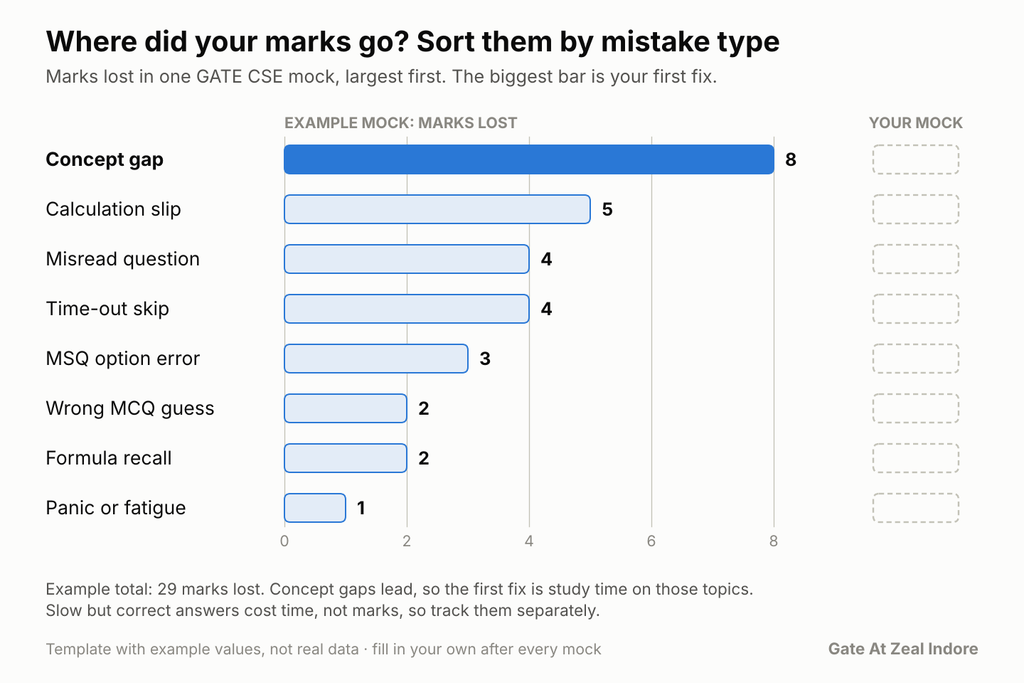
Give each wrong, skipped or slow question exactly one tag. After a few GATE CSE mock tests, the tags show a pattern that a total score never will.
| Mistake type | How to spot it | Fix |
|---|---|---|
| Concept gap | You cannot solve it even the next day with time | Re-study the topic, then solve 15 to 20 past GATE questions on it |
| Formula or fact recall | You knew it once but forgot the result or rule | Add it to a one-page formula sheet; revise the sheet daily |
| Calculation slip | Right method, wrong arithmetic or a dropped term | Write steps on the scribble pad; re-check NAT answers before you submit |
| Misread question | You answered a different question: missed “not”, units, base or range | Underline the ask before solving; read MSQ options twice |
| MSQ incomplete or extra option | One option missed or one wrong option ticked | Judge each option separately as true or false |
| Wrong guess on MCQ | Guessed between options you could not narrow | Guess only after ruling out at least two options |
| Time-out skip | Never reached it, or abandoned it for time | Fix the order and the time limits in the next section |
| Panic or fatigue | Errors pile up in the last hour | Take full three-hour mocks at your real exam time slot |
| Slow but correct | Right, but took far longer than its marks deserve | Practise timed sets on that topic to build speed |
Read the pattern, not one mock
One bad mock can be noise. Look at the tag counts across your last three or four mocks:
- Mostly concept gaps: you need study time, not more mocks.
- Mostly slips and misreads: your knowledge is ahead of your exam habits; drill accuracy.
- Mostly time-out skips: your order and pacing need work.
- Mostly wrong guesses: tighten your guessing rule and protect your MCQ marks.
The largest bucket is your first fix. Moving marks out of it is how mock scores rise.
Subject-wise analysis for CSE
The CS paper spreads across ten syllabus sections plus General Aptitude, so one total hides a lot. Fill a tracker like this after every mock. Copy the table into your notebook or a sheet and add one column per mock.
| Section | Marks attempted | Marks scored | Wrong (MCQ / MSQ / NAT) | Top mistake type | Next action |
|---|---|---|---|---|---|
| General Aptitude | |||||
| Engineering Mathematics | |||||
| Digital Logic | |||||
| Computer Organization and Architecture | |||||
| Programming and Data Structures | |||||
| Algorithms | |||||
| Theory of Computation | |||||
| Compiler Design | |||||
| Operating System | |||||
| Databases | |||||
| Computer Networks |
How to read the tracker
- Accuracy per section: marks scored divided by marks attempted. A section with high attempts and low accuracy is costing you negative marks.
- Attempt rate per section: a section you keep skipping is either a concept gap or a confidence gap. Re-solving the skips the next day tells you which.
- Trend over mocks: compare each section with the last three mocks, not just the last one. A section that stays flat while others rise is your next study block.
- Mistake type per section: the same subject can fail for different reasons. Slips in Computer Organization call for a different fix than concept gaps in Theory of Computation.
Weight the fix by marks
Not every weak section deserves equal time. Check how many marks each section has carried in recent official CS papers, available on the GATE 2027 download page, and spend more time where a weak section meets a high-mark area. Our 80+ marks strategy for GATE CSE covers subject targets in more detail.
Time analysis: attempts, time per question and when to skip
Time is the hidden cost in every GATE CSE mock test. The paper gives you 180 minutes for 65 questions and 100 marks. That is about 1.8 minutes per mark on average, so a 1-mark question deserves under 2 minutes and a 2-mark question under 4, with room left to review.
What to measure after each mock
- Time per question type and section. Most mock platforms show it; if yours does not, note start and end times for each block you solve.
- Questions that took more than double their share. List them. These are where marks leak.
- Your checkpoints. How many marks you had attempted at the one-hour and two-hour marks.
- The last 30 minutes. Count errors made in the final half hour against the first. A jump suggests fatigue or rushing.
Set a skip rule and test it
A simple rule is enough: if a question has no clear path after a fixed time, mark it and move on. A common starting point is about 2 minutes for a 1-mark question and 4 for a 2-mark one, then adjust from your own data.
After the mock, check every skipped question:
- Solved easily the next day: you skipped too early, or panic set in. Practise staying calm on first read.
- Solved only with a long effort: the skip was right. The time went to questions that paid.
- Could not solve at all: the skip saved time. Add the topic to your study list.
Find an order that works for you
There is no single correct order. Some students start with General Aptitude to settle in; others start with their strongest subject. Try two orders across different mocks and keep the one that gives more marks by the two-hour mark.
Keep the order fixed once you choose it. Changing strategy in the exam hall is a risk you can avoid by settling it in mocks.
Negative marking and accuracy: the math
The official pattern deducts 1/3 mark for a wrong 1-mark MCQ and 2/3 mark for a wrong 2-mark MCQ. MSQ and NAT carry no negative marks. That single rule should shape how you read every mock.
What a guess is worth on a four-option MCQ
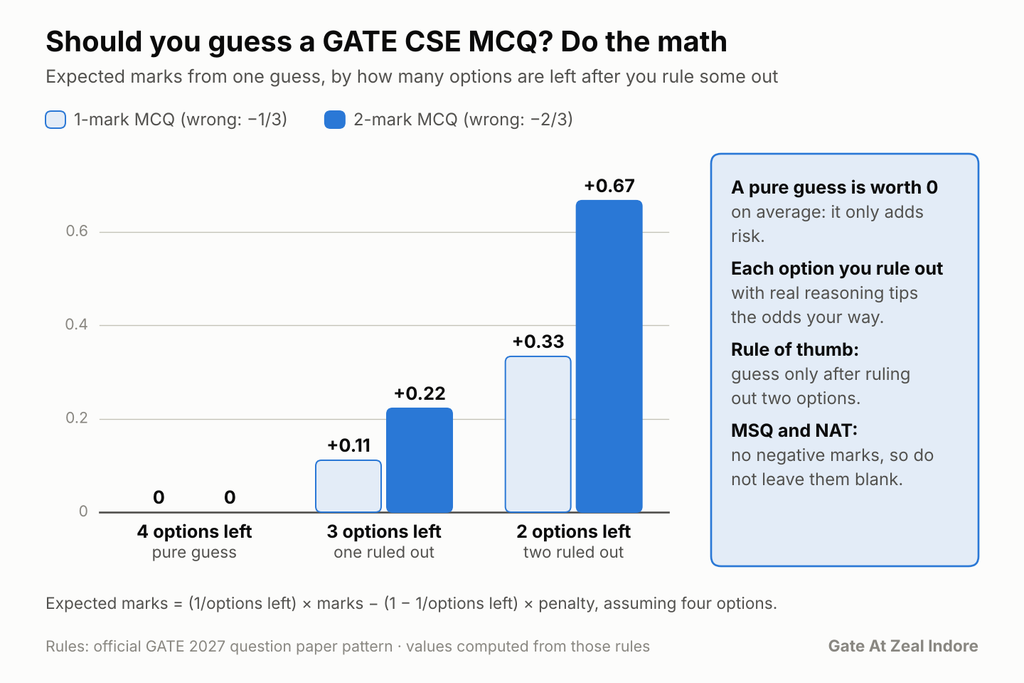
The expected marks from a guess depend on how many options you can rule out first:
| Options left when you guess | 1-mark MCQ | 2-mark MCQ |
|---|---|---|
| 4 (pure guess) | 0 | 0 |
| 3 (one ruled out) | +0.11 | +0.22 |
| 2 (two ruled out) | +0.33 | +0.67 |
A pure guess is worth nothing on average and only adds risk. Each option you can rule out with real reasoning moves the odds in your favour. That is why this guide suggests guessing only after ruling out two.
MSQ and NAT: attempt, but check
A wrong MSQ or NAT answer costs no marks, so leaving one blank throws away a chance. But MSQ has no partial marks, so a careless extra option scores zero. For NAT, check units, rounding and the range the question asks for before you submit.
Measure your negative marks every mock
Add two numbers to your tracker after each mock:
- Negative marks lost: the total deducted for wrong MCQs.
- MCQ accuracy: correct MCQs divided by attempted MCQs.
If the negative marks are large, look at the wrong MCQs. Were they guesses, slips or concept gaps? Wrong guesses mean a tighter guessing rule; slips mean slower final checks; concept gaps mean study.
Turn the analysis into a weekly study plan
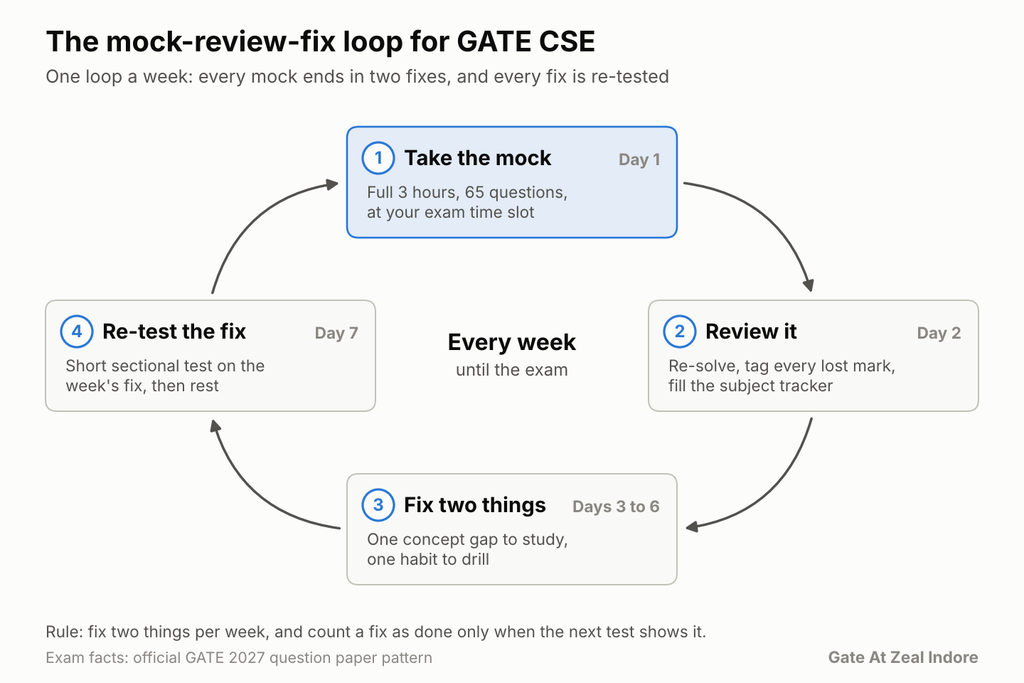
Analysis only raises marks when it changes what you do next. Use a simple loop between mocks: mock, review, fix, then mock again.
A sample week with one full mock
| Day | Task |
|---|---|
| Day 1 | Full three-hour mock at your exam time slot, then Sitting 1 (first-hour notes) |
| Day 2 | Sitting 2: re-solve, tag mistakes, fill the tracker, write the error log |
| Day 3 | Fix 1: study the biggest concept gap and solve past GATE questions on it |
| Day 4 | Fix 2: drill the top habit problem, such as timed sets for speed or MSQ option checks |
| Day 5 | Mixed practice from your error log, plus General Aptitude |
| Day 6 | Revise the formula sheet and re-solve old error-log questions without hints |
| Day 7 | Light day: short sectional test on the week’s fix, then rest |
Rules that keep the loop honest
- Fix two things per week, not ten. Two fixes done well move marks; a long list gets ignored.
- Re-test every fix. A topic is fixed only when you get similar questions right in the next mock or sectional test.
- Keep the error log alive. Re-solve old entries every week. A mistake that returns twice needs a different approach.
- Do not chase new material the day before a mock. Use it for revision, so the mock measures what you know.
Gate At Zeal Indore recommends this mock-review-fix loop for GATE 2027 aspirants, so each mock leads to two clear tasks instead of a vague promise to study harder.
How many GATE CSE mock tests to take, and when
There is no official number. What matters is that every mock gets a full review before the next one. As of 9 October 2026, the first GATE 2027 exam weekend is 6 and 7 February 2027, per the official dates page. That leaves about 17 weeks; check the official schedule for the exact day of the CS paper.
A pacing plan from now to the exam
- October to November: topic and sectional tests. Finish the syllabus first. Take one full mock every two weeks to set a baseline and find your weak sections.
- December: one full mock a week. Use the weekly loop above. This is where the tracker starts to show trends.
- January: two full mocks a week. Keep two review days per mock. Add official past CS papers as full mocks under exam timing.
- Final week before your paper: light practice. One last mock early in the week at most, then revision of your formula sheet and error log, and rest.
Signs you are taking too many mocks
- You start the next mock before you have finished reviewing the last one.
- Your error log stops growing, or you stop re-solving it.
- The same mistake types keep coming back across three mocks.
If any of these happen, drop a mock and spend the time on fixes. A reviewed mock does more for your marks than two unreviewed ones.
Use official papers too
The GATE 2027 download page carries past question papers and answer keys, including CS papers. Solving them under a timer, then analysing them with this method, shows you the real exam’s style without guesswork.
Mistakes students make while analysing mocks
- Looking only at the total and the rank. A rank in a mock series reflects that series’ takers, not GATE. Your mistake counts are more useful.
- Reading the solution first. Once you see the answer, every question looks easy. Re-solve without help first, so you know the real cause.
- Skipping the review of correct answers. Lucky guesses and slow solves hide inside your correct answers.
- Treating every wrong answer as a concept gap. Many lost marks are slips, misreads and time problems that more study will not fix.
- Keeping no written record. Without a tracker and error log, the same mistake can repeat for weeks unnoticed.
- Changing strategy every mock. Try one change at a time, so you can tell what worked.
- Taking mocks at a random time of day. Take full mocks at the time of your exam slot when you can, so your focus is trained for it.
- Ignoring General Aptitude. It is 15 marks in every GATE paper and deserves its own line in your review.
Frequently asked questions
How do I analyse a GATE CSE mock test?
Split your score by subject and question type, then tag every wrong, skipped and slow question with one mistake type. Count negative marks and time spent, and turn the two biggest problems into tasks before the next mock.
How long should mock test analysis take?
Plan for roughly as much time as the mock itself, split into a short review right after the test and a longer one the next day. A three-hour mock usually needs a similar amount of review to be useful.
How many GATE CSE mock tests should I take for GATE 2027?
There is no official number. A practical pace is one full mock every two weeks while finishing the syllabus, weekly in December and two a week in January, as long as each mock is fully reviewed.
Should I guess on MCQs in GATE CSE?
Only after ruling out options. A wrong 1-mark MCQ costs 1/3 mark and a wrong 2-mark MCQ costs 2/3 mark, so a pure guess among four options is worth zero on average. Ruling out two options makes a guess worth it.
Why are my mock scores not improving?
A common reason is that the same mistake types repeat. Check your tracker: if most lost marks are slips, misreads or time-outs, more study will not help; drill accuracy, reading and pacing instead.