


Ask ten GATE aspirants when they plan to start solving GATE previous year question papers, and most will give some version of the same answer: “once I finish the syllabus” or “in the last two months, for revision.” It’s the default advice, repeated so often it’s rarely questioned — save the PYQs, use them to check your readiness right before the exam. It’s also, for most students, the wrong call.
Previous year papers aren’t a revision tool you deploy once at the end. Used from the very first week of preparation, they’re a calibration tool, a weightage map, and a habit-builder — three things that only pay off if you start early enough to act on what they tell you. This guide makes the case for solving GATE previous year question papers from day one rather than saving them for a last-minute cram, lays out a practical method for doing it without running out of material, and shows how this fits into the broader six-month runway most GATE 2027 aspirants have between now and February. Throughout, we’ll draw on how Gate At Zeal Indore actually structures PYQ practice into its teaching, rather than treating it as an afterthought bolted onto the final weeks.
The Traditional (and Flawed) Advice: “Save PYQs for the End”
The logic behind saving previous year papers for later usually comes down to two fears, and both are weaker than they sound.
“I’ll run out of material if I start too early.” GATE has been conducted for well over two decades, across multiple papers each year, which means there are hundreds of previous year questions available per subject even for a single branch. Solving topic-relevant PYQs the moment you finish a topic — rather than hoarding the entire archive for a single end-of-preparation binge — doesn’t come close to exhausting the material. If anything, spreading PYQ practice across your whole preparation timeline means you actually get through more of it, more thoroughly, than a rushed final-month sprint ever could.
“I don’t want to see questions early and lose the ability to test myself later.” This assumes GATE repeats exact questions year to year, which it doesn’t. GATE recycles concepts, question styles, and the specific ways a topic tends to get tested — not the literal questions themselves. Solving a 2019 question on a topic doesn’t spoil a 2024 question on the same topic; if anything, understanding how that concept has been tested across multiple years is exactly what prepares you for however it gets tested in your own attempt.
Once both of these fears are addressed, the case for saving PYQs for later loses its foundation — and the case for starting early gets a lot stronger.
Also Read: Data Structures & Algorithms for GATE: Most-Asked Topics in Last 10 Years
Why Solving GATE Previous Year Question Papers From Day 1 Works Better
1. It Calibrates What “Knowing a Topic” Actually Means at GATE Level
There’s a wide gap between “I understood this chapter” and “I can solve a GATE-level question on this chapter in under two minutes.” Reading notes or watching a lecture tells you nothing about where that gap actually is — solving the real previous year questions on that exact topic, right after you’ve studied it, tells you immediately. A student who waits until the end to find this out discovers, often for the first time, that their sense of “mastery” was calibrated against the wrong bar — and by then there’s little time left to recalibrate.
2. It Reveals Topic Weightage Early, So You Can Study Proportionally From the Start
Every GATE subject has topics that show up in nearly every year’s paper, and others that appear rarely. Solving PYQs topic by topic as you go reveals this weightage in real time — so you can consciously spend more hours on the consistently-tested areas and less on the ones that show up once every few years. A student who only discovers this pattern in the final revision phase has already spent five months distributing study time roughly equally across topics that were never distributed equally in the actual exam.
3. Spaced Practice Beats Cramming for Long-Term Retention
This isn’t just study folklore — spaced repetition (revisiting material at increasing intervals rather than in one concentrated block) is one of the more consistently replicated findings in learning research, and it applies directly here. Solving a topic’s PYQs right after learning it, then again a few weeks later, then again a couple of months after that, builds retention that a single last-minute pass simply can’t match, no matter how intensely that final pass is done. Cramming produces short-term recognition; spaced practice produces the kind of durable recall you actually need three, four, or six months later on exam day.
4. It Builds the Right Study Habits From the Beginning
A student who spends the first five months of preparation purely reading theory and only starts solving GATE-style questions in the sixth month has spent five months training themselves to absorb information, not to solve problems under GATE’s specific format — a mix of MCQ, MSQ, and numerical answer type (NAT) questions, each testing you differently. Retraining that habit — shifting from passive reading to active, timed problem-solving — under the pressure of a final one- or two-month window is far harder than simply building the right habit from week one. Solving PYQs from day one means every study session, from the very start, is oriented toward the actual skill the exam tests.
5. It Compounds Confidence Instead of Concentrating Anxiety at the End
Preparation that’s purely theoretical for months and only “tested” at the very end creates a high-stakes, nerve-wracking reveal right when a student can least afford a confidence hit. Solving PYQs from the start means small, steady wins (and small, manageable failures) are distributed across the whole preparation period — so confidence builds gradually and realistically, instead of being gambled on a single late-stage cram session that can go either way psychologically.
6. It Becomes a Real, Measurable Progress Log
A PYQ set solved in month one and re-attempted in month four isn’t just repetition — it’s a genuine before-and-after checkpoint. If your accuracy and speed on that same topic’s questions have improved, you have concrete evidence your preparation is working. Students who only touch PYQs once, at the end, never get this kind of longitudinal signal — they get a single, final data point with no time left to respond to it either way.
Also Read: How to Master Operating Systems for GATE CS in 30 Days
Two Students, Two Approaches: A Realistic Comparison
Consider two students with roughly equal aptitude, starting GATE 2027 preparation at the same time in August.
Student A follows the traditional path: read theory and solve textbook problems for five months, then spend the sixth month solving previous year papers for the first time. In that final month, Student A discovers three uncomfortable things simultaneously — several topics they thought they understood turn out to be tested in ways they didn’t anticipate, a handful of high-weightage topics they under-studied relative to how often they actually appear, and that their problem-solving speed under GATE’s format is far slower than their comfort with theory suggested. There’s no time left to properly fix any of the three.
Student B solves topic-wise PYQs immediately after each topic from month one. Early sets are humbling — low accuracy, slow timing — but by month three, Student B has already identified and revisited their genuinely weak topics twice, has a clear sense of which subjects deserve more hours based on real weightage evidence, and has spent five months getting comfortable with GATE’s actual question format instead of one. The final month, for Student B, is about full-length simulation and fine-tuning, not first-time discovery of fundamental gaps.
Same starting point, same aptitude, same total study hours — a meaningfully different outcome, driven almost entirely by when PYQ practice started relative to when its findings could still be acted on.
PYQs Also Train You for the Exam’s Actual Interface, Not Just Its Content
One underrated benefit of early, regular PYQ practice: GATE’s computer-based format has its own mechanics that have nothing to do with subject knowledge — selecting multiple correct options in an MSQ without a stray extra click, typing a precise numerical answer for NAT questions within the expected format and decimal precision, navigating between questions and flagging ones to revisit under a visible countdown timer. These are small frictions, but under three hours of real exam pressure, small frictions compound.
A student solving PYQs from day one, ideally in a format that mirrors the actual computer-based interface, builds familiarity with these mechanics gradually and unconsciously. A student encountering this interface seriously for the first time in a last-minute mock has one more unfamiliar variable to manage in exactly the week they can least afford it — on top of, not instead of, the content itself.
Also Read: GATE 2026 Cutoff Trends: What Score Do You Need for IIT/IISc/PSUs?
The Day-1 PYQ Method: How to Actually Do This
Starting PYQs from day one doesn’t mean opening every previous year paper in your first week — that would just recreate the “running out of material” problem in reverse, and burn through valuable full-length simulation material too early. Here’s a structure that avoids that:
- Topic-wise sweep, immediately after learning each topic. As soon as you finish a topic in your syllabus, pull every previous year question tagged to that specific topic (not the full paper) and solve them as a set.
- Analyse the pattern, not just the score. For each question, note whether it’s a direct formula application, a conceptual trap, a multi-step numerical, or a comparison-style question. This tells you how GATE tends to test that topic — information that shapes how you approach studying the next topic too.
- Keep a running tracker, logging accuracy and time-per-question by topic, so patterns across your whole preparation become visible rather than each session feeling isolated.
- Revisit weak topics on a spaced schedule — a few weeks after the first attempt, then again a couple of months later — rather than only when it’s convenient.
- Deliberately hold back the two or three most recent years’ full papers, untouched, until the final phase of preparation. This is the key nuance: “day one” applies to topic-wise practice, not to your entire PYQ archive. Save the freshest, most recent full papers specifically for realistic, full-length, timed simulation closer to your exam date — that’s a different exercise from topic calibration, and it deserves untouched material.
This structure gets you the calibration and habit-building benefits of starting early, without sacrificing the value of a few completely fresh, full-length papers for late-stage exam simulation.
What Last-Minute-Only PYQ Revision Actually Costs You
If starting early is this valuable, it’s worth being specific about what a last-minute-only approach quietly costs:
- False mastery through recognition, not recall. By the time PYQs are widely discussed — in coaching sessions, YouTube walkthroughs, and forums — solving them for the first time in the final weeks risks a subtle trap: recognising a question style you’ve half-seen before, and mistaking that recognition for genuine problem-solving ability.
- No runway left to fix what you discover. A gap found in month six has nowhere to go. A gap found in month one has five more months to be closed properly.
- A single, compressed, high-stress testing window instead of steady, distributed practice — which is worse for both learning and psychological readiness heading into exam day.
- No weightage awareness during the months when it would have actually changed your study allocation. Discovering which topics are heavily tested after you’ve already distributed your time equally across all of them is information that arrives too late to use.
How This Fits Your Broader GATE 2027 Preparation Timeline
With the GATE 2027 exam running across six dates in February 2027, and the application window open since 14 August 2026, most aspirants are roughly six months out right now — which makes this the right moment to build PYQ practice into your routine from the start, rather than treating it as a future task.
Layer it in like this: as each topic is completed in the early months, immediately follow it with a topic-wise PYQ sweep before moving to the next topic — don’t let “finish the syllabus first” become an excuse to defer this. As your syllabus nears completion in the middle months, shift toward subject-wise PYQ sets that combine several related topics. In the final two months, bring in full-length mock tests and test series alongside your held-back recent-year PYQ papers for genuine exam simulation. This isn’t a replacement for a structured test series — the two work together, with PYQs teaching you the exam’s history and patterns from day one, and a test series stress-testing you on material you haven’t already seen.
Gate At Zeal’s Approach to Previous Year Question Papers in Indore
At Gate At Zeal Indore, previous year questions aren’t treated as a separate, end-of-course add-on — they’re woven directly into how each topic is taught. The institute maintains a dedicated CS/IT previous year question paper resource, and faculty teaching each subject area — Ashish Sharma on Operating Systems, DBMS, Computer Organisation & Architecture, Computer Networks, and Digital Logic; Basant Kumar Jha on Mathematics, Discrete Structures, Theory of Computation, and Compiler Design; Archit Shukla on C Programming, Operating Systems, and Discrete Mathematics — consistently connect topics to how they’ve actually been tested in past GATE papers, not just the theory in isolation.
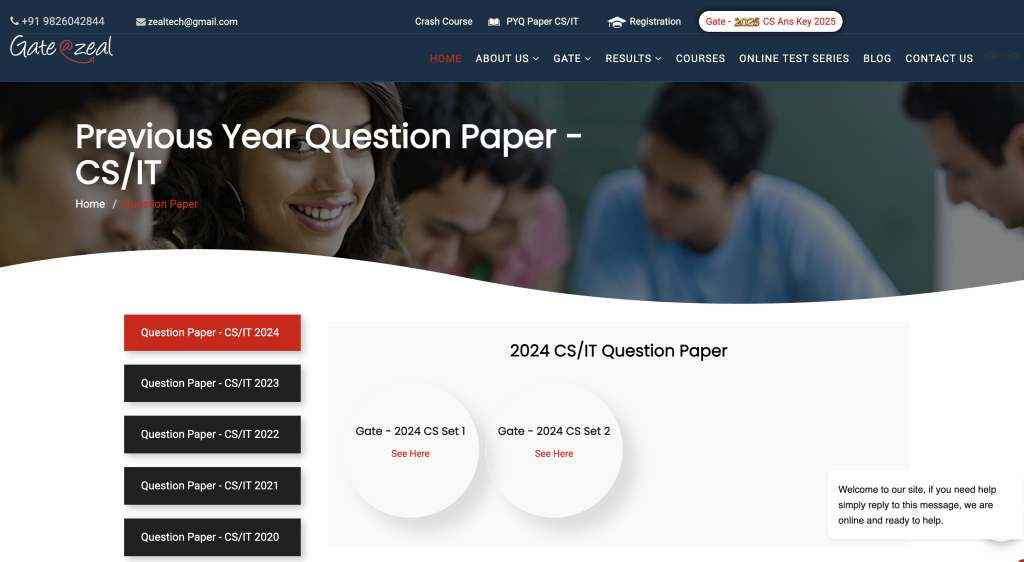
This lines up directly with the “compact and precise syllabus coverage” approach the institute is built around: rather than teaching a topic broadly and hoping relevance becomes clear later, connecting it to real, previously-tested GATE questions from the start makes the exam-relevant boundaries of each topic clear immediately. You can find Zeal’s CS/IT previous year question papers directly on their site, and pair that early-stage PYQ practice with their online test series for the fresh, full-length simulation phase later in your preparation.
FAQs: GATE Previous Year Question Papers
Should I solve GATE PYQs from the very first day of preparation? Yes, in a specific way — solve topic-wise PYQs immediately after finishing each topic, rather than saving the entire archive for the end. This calibrates your understanding against real GATE difficulty from the start and reveals topic weightage early enough to act on it.
How many years of GATE previous year papers should I solve? There’s no strict number, but working through a decade or more of topic-relevant questions across your preparation is realistic and valuable. The key structural tip is to hold back the two or three most recent years’ full papers, untouched, for full-length simulation later rather than solving everything immediately.
Will solving PYQs early spoil them for later revision? No. GATE reuses concepts and question styles across years, not identical questions, so solving a past year’s question on a topic doesn’t reduce the value of revisiting that topic later — especially with spaced, periodic re-attempts rather than a single pass.
What’s the difference between using PYQs for practice vs. a final mock test? Topic-wise PYQ practice, done early, is about calibration and habit-building on individual concepts. Full-length, recent-year PYQ papers used later are about simulating real exam conditions — timing, stamina, and mixed-topic pacing — which is why it’s worth keeping a few years’ papers untouched for this specific purpose.
Does GATE repeat questions from previous years? Not exact questions, but it consistently reuses underlying concepts, question formats, and the specific ways certain topics tend to be tested — which is exactly why studying previous year papers, across many years, is such a reliable way to understand what the exam actually rewards.
Where can I get GATE CS/IT previous year question papers in Indore? Gate At Zeal Indore maintains a dedicated CS/IT previous year question paper resource, with faculty connecting each topic directly to how it’s historically been tested in GATE, integrated into the teaching itself rather than left as a separate final-revision task.
Is it too late to start solving PYQs if I’ve already covered most of my syllabus? No — starting now is still far better than waiting until the very end. You’ll simply move faster through the topic-wise sweep since your syllabus is already covered, and you’ll still benefit from weightage awareness and spaced revisits, just with a shorter runway than a student who started from week one.
Should I time myself while solving GATE PYQs from day one? Not initially. In the early calibration phase, focus on accuracy and understanding the question pattern without the pressure of a clock. Introduce strict timing once you move into subject-wise sets and, later, full-length simulations with your held-back recent-year papers.
Conclusion: Start With PYQs, Don’t Save Them
GATE previous year question papers work best as a tool you use from week one, not a stack you save for the final sprint. Solved topic by topic, right after you learn each concept, they calibrate what real GATE-level mastery looks like, reveal exam weightage early enough to act on it, and build the exact problem-solving habits the exam actually tests — all while a handful of recent, untouched years wait patiently for genuine full-length simulation closer to February 2027.
If you’re structuring your GATE 2027 preparation and want PYQ practice built into your learning from the start rather than bolted on at the end, that’s exactly how Gate At Zeal Indore approaches it — connecting each topic to real, previously-tested questions as you learn it, not months later when there’s no time left to act on what you find. Six months is enough time to build this habit properly; the only real mistake is waiting.