


“What’s the GATE cutoff?” is one of the most-searched GATE questions — and one of the most misleading to answer with a single number. GATE cutoff actually means three different things depending on who’s asking: the bare qualifying mark to say you’ve “passed” GATE, the GATE Score that gets you into a specific IIT’s M.Tech programme, and the (usually much higher) score a PSU sets for its own recruitment. Preparing for the wrong one is a common, costly mistake.
Gate At Zeal Indore breaks down real GATE cutoff data from recent years below, and what it means for setting a realistic target for GATE 2027.
Quick answer: GATE qualifying cutoffs (out of 100 marks) typically sit in the 25–30 range for General category depending on branch. IIT M.Tech admission for CSE at a top IIT needs a GATE Score of roughly 800–870 (out of 1000) for General category. PSU recruitment cutoffs are usually higher still and vary sharply by company and branch — ONGC’s Instrumentation cutoff, for instance, has touched close to 994 out of 1000. GATE 2027 cutoffs don’t exist yet, but recent-year patterns are the best available reference point.
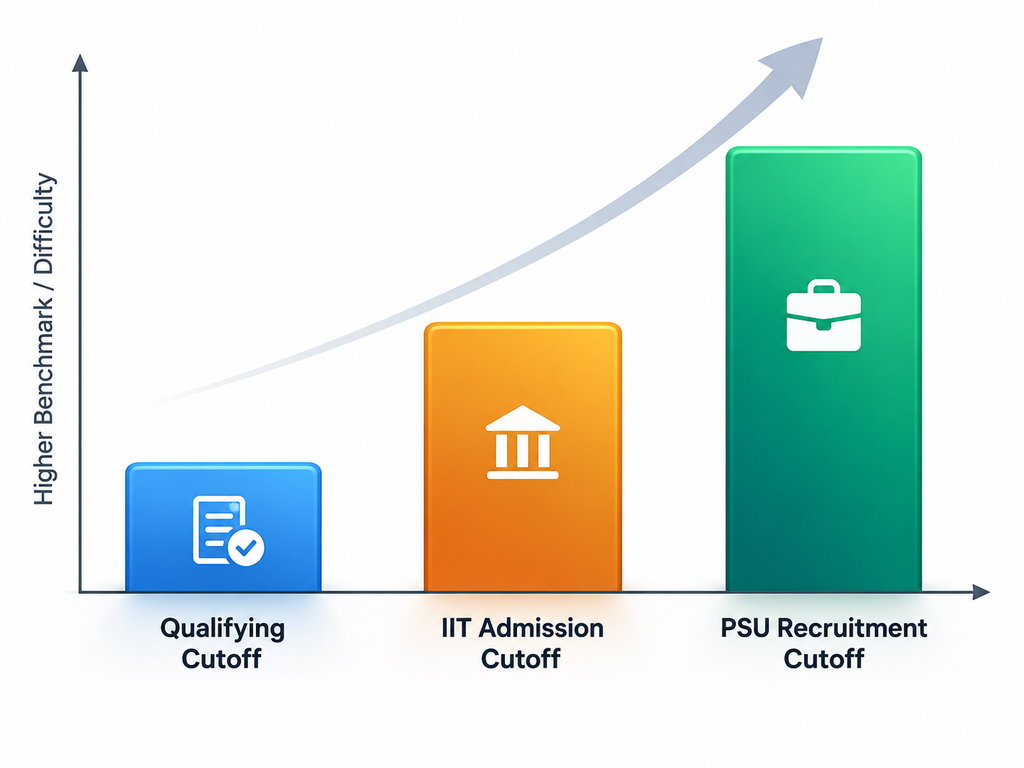
GATE Cutoff vs GATE Score: Get This Distinction Right First
Before any numbers matter, three terms need separating:
- Qualifying cutoff — the minimum marks (out of 100) needed to be declared “qualified” in GATE, published separately by branch and category
- GATE Score — a normalized score out of 1000, calculated from your marks, used for M.Tech admissions and most PSU shortlisting
- Admission/recruitment cutoff — the actual closing GATE Score at a specific IIT, NIT, or PSU, which is always higher than the bare qualifying cutoff and changes every year based on vacancies and applicant pool
A student who “qualifies” GATE and a student who gets into IIT Bombay’s CSE M.Tech program can be separated by 800+ points on the GATE Score scale. Most of the confusion in gate exam preparation planning comes from mixing these up.
GATE Qualifying Cutoff by Branch (Recent Year, Marks Out of 100)
| Branch | General | OBC-NCL/EWS | SC/ST/PwD |
|---|---|---|---|
| Computer Science & IT | 30 | 27 | 20 |
| Civil Engineering | 28.7 | 25.8 | 19.1 |
| Electrical Engineering | 27.7 | 24.9 | 18.4 |
| Electronics & Communication | 26.4 | 23.7 | 17.5 |
| Data Science & AI | 26.4 | 23.7 | 17.5 |
| Mechanical Engineering | 25.2 | 22.6 | 16.7 |
This is the floor, not a target — it only confirms you’re “GATE qualified,” not competitive for a specific IIT seat or PSU role.
Also Read: GATE 2027 Eligibility Criteria: Who Can Apply
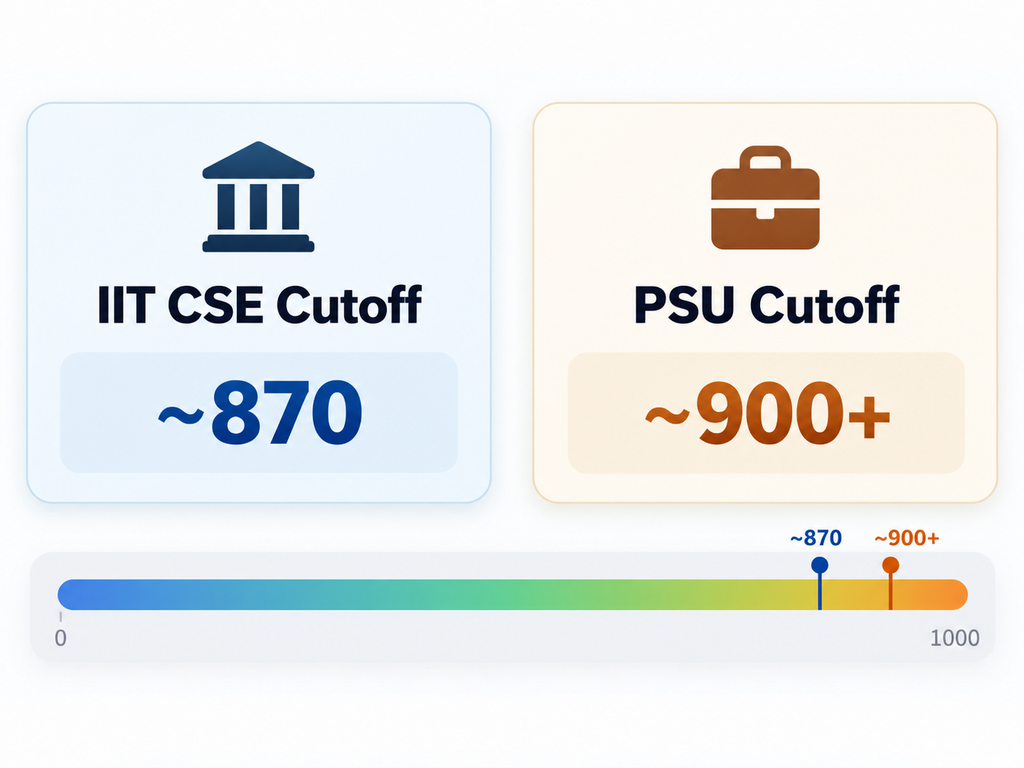
GATE Cutoff for IIT M.Tech Admission (GATE Score Out of 1000)
Here’s where the real competition shows up. For CSE — GATE’s most competitive branch — recent closing GATE Scores by category looked like this across top IITs:
| IIT | General/EWS | OBC-NCL | SC | ST |
|---|---|---|---|---|
| IIT Bombay | ~870 | ~820 | ~750 | ~680 |
| IIT Delhi | ~855 | ~805 | ~730 | ~655 |
| IIT Madras | ~835 | ~785 | ~705 | ~625 |
| IIT Kanpur | ~820 | ~770 | ~690 | ~610 |
| IIT Kharagpur | ~800 | ~750 | ~670 | ~590 |
| IIT Roorkee | ~780 | ~730 | ~650 | ~570 |
| IIT Hyderabad | ~760 | ~710 | ~630 | ~550 |
| IIT Guwahati | ~740 | ~690 | ~610 | ~530 |
A rough branch pecking order across IITs: CSE tops the list, followed by Electrical, then Electronics, then Mechanical — with Civil and Chemical typically running lower. And a pattern worth remembering: OBC-NCL candidates generally need about 90% of the General closing score, while SC/ST candidates need roughly 65–70%.
One more thing that catches candidates off guard: closing scores tend to drop in later COAP counselling rounds as top scorers lock in higher-preference seats and move out of the pool — so an early-round cutoff isn’t the full picture.
GATE Cutoff for PSU Recruitment: Why It’s a Different Game
This is the part most “GATE cutoff” content skips — PSU recruitment cutoffs don’t follow the same scale or logic as IIT admissions, and they’re frequently more competitive, not less. A recent recruitment cycle showed cutoffs like:
| PSU | Branch | Cutoff |
|---|---|---|
| IOCL | Electrical Engineering | 92.95 (out of 100 marks) |
| IOCL | Mechanical Engineering | 71.82 (out of 100 marks) |
| IOCL | Civil Engineering | 69.92 (out of 100 marks) |
| IOCL | Computer Science | 64.29 (out of 100 marks) |
| IOCL | Electronics & Comm. | 61.05 (out of 100 marks) |
| ONGC | Instrumentation | 994 (GATE Score out of 1000) |
| ONGC | Electronics & Comm. | 898 (GATE Score out of 1000) |
| ONGC | Civil Engineering | 878 (GATE Score out of 1000) |
| ONGC | Electrical Engineering | 846 (GATE Score out of 1000) |
| ONGC | Mechanical Engineering | 842 (GATE Score out of 1000) |
| Coal India Limited | Mechanical Engineering | 868 (GATE Score out of 1000) |
| Coal India Limited | Electrical Engineering | 838 (GATE Score out of 1000) |
Notice something: ONGC’s GATE-Score-based cutoffs (842–994) sit well above even IIT Bombay’s CSE admission cutoff (~870). PSUs recruit for a small number of seats against a huge applicant pool, and every PSU sets its own cutoff independently — there’s no single “PSU cutoff” the way there’s a rough IIT pecking order. Note also that PSUs mix scales too: some (like IOCL) publish cutoffs as marks out of 100, others (like ONGC and Coal India) use the GATE Score out of 1000 — always check which scale a specific PSU notification uses before comparing your own score.
What Score Should You Actually Target for GATE 2027?
GATE 2027 cutoffs don’t exist yet — anyone giving you an exact number is guessing. What recent-year data does support is a realistic target range:
- To comfortably qualify: aim well clear of the 25–30 (out of 100) qualifying range — treat it as a floor, not a goal
- To be competitive for a top-IIT M.Tech seat in a popular branch: target a GATE Score in the 750–850+ range, adjusted for your branch and category
- To be competitive for PSU recruitment: target scores at or above the higher end of recent PSU cutoffs for your specific branch and company of interest, since these often exceed IIT admission thresholds
Build your gate exam preparation plan around the higher of these two targets if you’re keeping both options open — preparing only to “qualify” leaves you short of both.
Why GATE Cutoffs Move Every Year
Cutoffs aren’t fixed, and a few factors specifically matter for GATE 2027:
- Number of candidates and paper difficulty — a harder paper usually pulls the qualifying cutoff down; a larger, better-prepared applicant pool can push admission/recruitment cutoffs up
- Vacancies — IIT seat counts and PSU hiring numbers shift year to year, independent of exam difficulty
- Syllabus changes — GATE 2027’s revised syllabus and new Robotics & Automation paper mean this year’s difficulty curve, and therefore its cutoffs, may not track smoothly from previous years
Also Read: GATE 2027 New Syllabus: Branch-Wise Changes
Gate At Zeal Indore tracks cutoff trends branch-by-branch each cycle to help students set realistic, category-adjusted targets rather than preparing against a single generic number.
Also Read: Gate At Zeal Indore — GATE 2027 Coaching
FAQ
What is the GATE cutoff for 2027?
GATE 2027 cutoffs won’t be known until results are declared in mid-March 2027. Recent-year qualifying cutoffs have ranged roughly 25–30 out of 100 for General category depending on branch, but admission and recruitment cutoffs run far higher.
What GATE score is needed for IIT M.Tech admission?
For a competitive branch like CSE, recent GATE Score cutoffs at top IITs ranged from roughly 740 (IIT Guwahati) to 870 (IIT Bombay) for General category, out of 1000, with lower thresholds for OBC-NCL, SC, and ST candidates.
Is the PSU cutoff higher than the IIT cutoff?
Often, yes. Recent PSU cutoffs, such as ONGC’s, have reached the 840–994 GATE Score range for some branches, higher than several IIT admission cutoffs for the same branch. PSU cutoffs vary by company and are set independently each recruitment cycle.
Why do GATE cutoffs change every year?
Cutoffs shift based on the number of candidates, exam difficulty, available seats or vacancies, and syllabus changes. GATE 2027’s revised syllabus and new Robotics & Automation paper add extra uncertainty to this cycle’s trend line.
What GATE score should I target for GATE 2027?
Aim well above the bare qualifying cutoff (25–30/100). For a top-IIT seat in a popular branch, target a GATE Score of roughly 750–850 or higher; for PSU recruitment, target at or above recent cutoffs for your specific branch and company, since these are often higher still.
Conclusion
GATE cutoff isn’t one number — it’s a floor to qualify, a moving target for IIT admission, and an even higher, company-specific bar for PSU recruitment. Recent-year data gives you a realistic range to prepare against for GATE 2027, even though the exact cutoff won’t be known until results are out.
If you want your target score set against your specific branch, category, and goal — IIT admission, PSU recruitment, or both — Gate At Zeal Indore can help you build a preparation plan around a realistic number, not a guess.