

Most GATE exam preparation advice you’ll find online was written for a syllabus that no longer exists. GATE 2027 carries the first major syllabus revision in five years — new topics, a restructured paper (RA), and expanded sections across almost every branch — which means a generic “how I cracked GATE” study plan can quietly leave gaps exactly where the exam has changed the most.
This guide from Gate At Zeal Indore covers how to prepare for GATE 2027 with the revised syllabus specifically — not a repeat of last year’s advice, and not limited to one branch.
Quick answer: With roughly 5 months left until GATE 2027 (6–21 February 2027), an effective study plan starting in September 2026 has five phases: audit the revised syllabus for your branch, prioritize genuinely new topics first (they have the least ready-made material), complete full syllabus coverage by November, run full-length mocks through December, and do calendar-matched final revision in January. gate exam preparation this cycle has to be revision-aware, not just syllabus-aware.
Why Your GATE 2027 Study Plan Needs to Account for the Revision
Before any study plan makes sense, it helps to know what actually changed. Across GATE 2027, the syllabus was revised branch-by-branch — CS/IT saw broader ML/AI/Data Analytics coverage, ECE added Vector Analysis and 5G/6G/IoT topics, Mechanical added Additive Manufacturing as a dedicated topic, Electrical added Smart Grid/EV/Energy Storage content, Civil added Sustainability and Green Construction, and Data Science & AI expanded into Generative AI and LLMs — alongside a brand-new Robotics & Automation paper.
Also Read: GATE 2027 New Syllabus: Branch-Wise Changes
The practical implication: some of your syllabus has years of previous-year questions and solved material behind it. Some of it — the genuinely new topics — has almost none. Treating both the same way is the single biggest planning mistake this year.
Step 1: Audit Your Branch’s Revised Syllabus Before You Open a Single Book
Before building a study schedule, spend a day mapping three lists for your specific paper:
- Unchanged topics — where old notes, PYQs, and standard reference books still apply directly
- Expanded topics — sections that got broader (more weightage likely, more practice needed, existing resources partly usable)
- Brand-new topics — content with little to no previous-year question bank, needing fresh study material from the start
This single exercise reshapes how much time each subject actually deserves — it’s the difference between a generic plan and one built for GATE 2027 specifically.
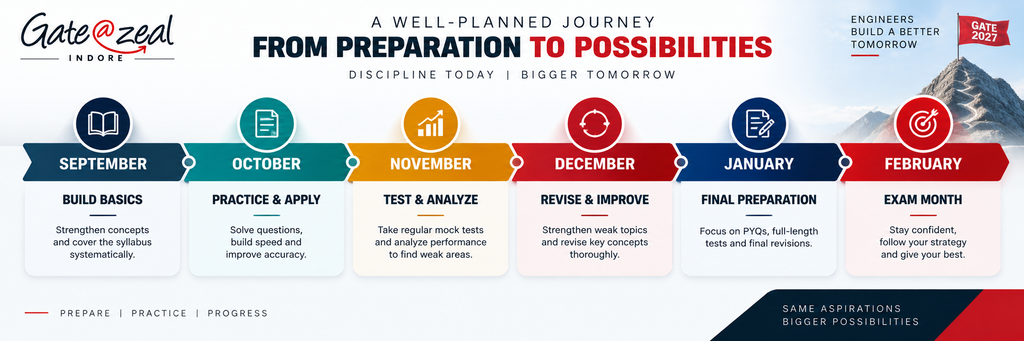
The 5-Month GATE 2027 Study Plan (Starting Now)
This plan assumes a September start against the confirmed GATE 2027 exam window of 6–21 February 2027.
September 2026: Registration + New-Topic Foundation
- Finish your GATE 2027 registration before the deadline — don’t let admin tasks eat into study time later
- Complete your syllabus audit (Step 1 above)
- Start with the genuinely new topics in your branch first, while you have the most runway to source and work through fresh material
October 2026: Core Syllabus, Branch by Branch
- Move through your core subjects systematically, following your branch’s standard subject sequence
- Keep new topics in rotation alongside core ones — don’t push them entirely to “later”
November 2026: Complete Coverage + Start Practice
- Finish first-pass coverage of the entire syllabus, old and new topics both
- Begin previous-year questions for unchanged/expanded topics, and fresh practice sets for new topics (ask your coaching resources specifically for GATE 2027-updated material, not recycled 2026 sets)
December 2026: Full-Length Mock Tests
- Start full-length mocks built to the actual GATE pattern — 100 marks, 65 questions, 15 marks General Aptitude
- Log every wrong answer by topic, not just by subject, so revision time in January is targeted, not generic
January 2027: Calendar-Matched Final Revision
- Your admit card releases on 3 January 2027 — confirm your exact date, session, and (if applicable) exam city and second-paper timing immediately
- Shift mocks to match your actual forenoon or afternoon session timing
- Prioritize revision on topics your error log flagged most, not a fresh re-read of everything
Also Read: GATE 2027 Exam Dates — Full Schedule
February 2027: Exam Window
- 6–21 February spans three weekends — treat each exam day as a checkpoint, not a single event, especially if you’re attempting two papers across different sessions
- No new topics from here — steady-state revision and rest only
How to Prioritize Time Within a Revised Syllabus
Not all topics deserve equal hours. As a rough allocation principle for this cycle:
- New topics (Additive Manufacturing, 5G/6G & IoT, Smart Grid/EVs, Generative AI/LLMs, Robotics & Automation basics, Sustainability/Green Construction, depending on your branch) — front-load these; they need the most original study time and the least competition for “settled” material
- Expanded topics (like CS’s broader AI/ML/Data Analytics coverage) — treat as higher-weightage; allocate more practice questions than you would have last year
- Unchanged topics — still essential, but your existing resources and PYQs remain reliable here, so they need less rebuilding-from-scratch time
Mock Test Strategy for a Revised-Syllabus Year
A mock test built entirely from pre-2027 previous-year questions will systematically under-test you on exactly the topics that changed. Before you trust a mock series:
- Confirm it’s been updated for the GATE 2027 syllabus, not just relabelled
- Cross-check that new topics in your branch actually appear in the mock, not just the old core subjects
- Treat your early full-length mocks in December as diagnostic, not predictive — this cycle’s real difficulty curve on new topics is still being calibrated by everyone, coaching institutes included
Common Mistakes When Preparing for GATE 2027 This Year
- Studying from last year’s notes without cross-checking the revision. Convenient, but silently incomplete.
- Saving new topics for “later” in the plan. They deserve earlier attention precisely because less material exists for them.
- Assuming your paper’s syllabus is untouched. Even branches with lighter revisions (like Civil) picked up new named topics worth specifically checking.
- Ignoring the admit card session details. With GATE 2027 spread across three weekends, your January revision should match your actual exam date and session, not a generic “exam month” push.
If you’re specifically preparing for GATE CS, Gate At Zeal Indore also has a dedicated month-wise CS strategy with subject-by-subject depth — use this guide for the revision-specific adjustments, and that one for the full CS-only roadmap. For other branches, Gate At Zeal Indore’s counsellors can help you build the same kind of syllabus-audit-first plan around your specific paper.
Also Read: Gate At Zeal Indore — GATE 2027 Coaching
FAQ
How should I prepare for GATE 2027 with the revised syllabus?
Start by auditing your branch’s syllabus to separate unchanged, expanded, and brand-new topics. Prioritize new topics early since they have the least ready-made material, complete full coverage by November, run full-length mocks through December, and revise against your actual exam date and session in January.
What’s different about gate exam preparation this year?
GATE 2027 carries its first major syllabus revision in five years, plus a new Robotics & Automation paper. Preparation built purely on last year’s material or mock tests risks under-covering exactly the topics that changed.
How many months do I need to prepare for GATE 2027?
A focused 5-month plan, starting around September 2026 for the February 2027 exam, is workable if you prioritize correctly — new topics first, full coverage by November, mocks in December, calendar-matched revision in January.
Which GATE 2027 topics should I prioritize?
Prioritize genuinely new topics in your branch (they have little previous-year material), then expanded topics (likely higher weightage), keeping unchanged topics on your existing resources and previous-year questions.
Are old GATE mock tests still useful for GATE 2027?
Partly. They remain useful for unchanged topics but won’t cover new additions like Additive Manufacturing, 5G/6G & IoT, Smart Grid/EVs, or Robotics & Automation — confirm any mock series is specifically updated for the GATE 2027 syllabus before relying on it.
Conclusion
How to prepare for GATE 2027 with the revised syllabus ultimately comes down to one shift in thinking: treat the syllabus revision as the starting point of your plan, not a footnote to it. A 5-month plan that fronts-loads the genuinely new content, keeps steady coverage through November, and revises against your real exam calendar gives you a realistic shot — even starting now.
Want this mapped to your specific branch and paper combination? Gate At Zeal Indore can build that plan with you.
Also Read: GATE 2027 Preparation Roadmap — Gate At Zeal
Also Read: GATE CSE 2027 Preparation Strategy: Month-Wise Plan — Gate At Zeal