

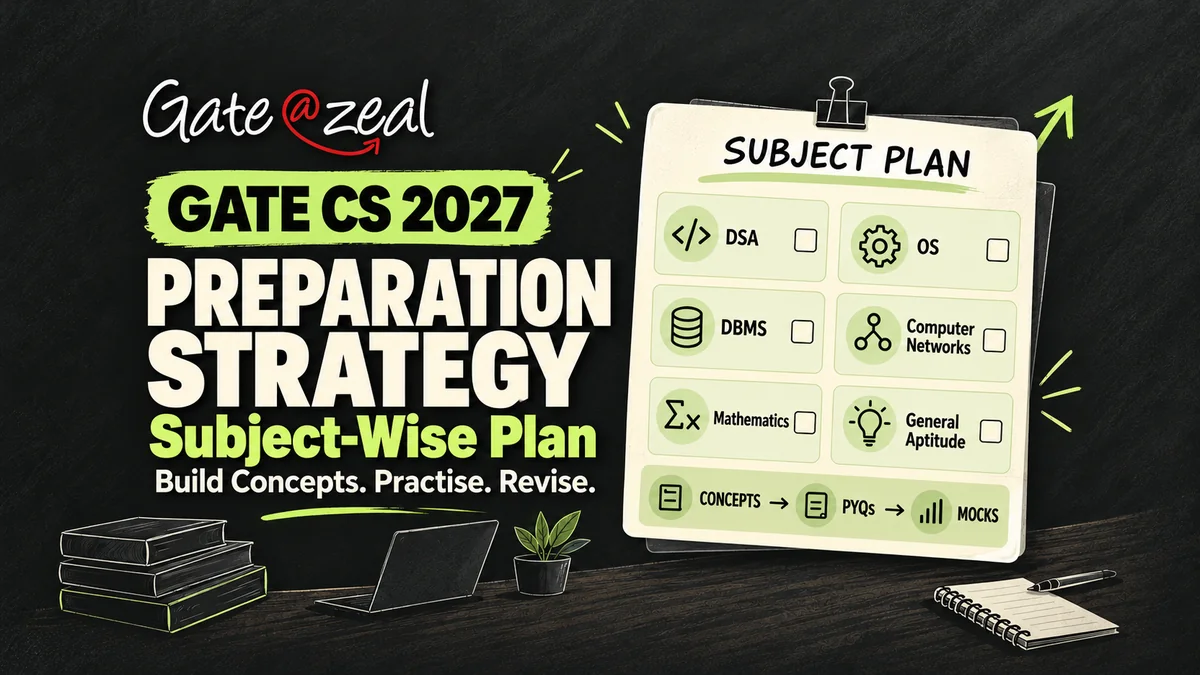
A strong GATE CS 2027 preparation strategy comes down to five moves:
- Plan from the revised GATE 2027 CS syllabus, which has ten sections, not from old notes.
- Build core subjects first: Engineering Mathematics, Programming and Data Structures, Algorithms, Operating System, Databases and Computer Networks.
- Practise past GATE CS questions topic-wise the same day you study each topic.
- Take full timed papers every week from December, two a week in January, and review each one.
- Protect the 15 General Aptitude marks with steady practice from day one.
The GATE 2027 exam runs on 6, 7, 13, 14, 20 and 21 February 2027. From 2 November 2026, the first exam day is 96 days away, and the paper-wise schedule is not out yet.
This guide from Gate At Zeal Indore lays out the full GATE CS 2027 preparation strategy: the paper, the syllabus, a subject-wise plan for all ten sections, a phase plan to the exam, and exam-day tactics for the CS paper.
GATE CS 2027 at a glance
| Feature | GATE 2027 CS (Computer Science and Information Technology) |
|---|---|
| Total marks | 100 |
| General Aptitude | 15 marks, common to all papers |
| CS subject questions | 85 marks |
| Questions | 65 |
| Duration | 3 hours |
| Question types | MCQ, MSQ and NAT |
| Calculator | On-screen virtual scientific calculator only |
| Exam days | 6, 7, 13, 14, 20 and 21 February 2027 (CS date not announced yet) |
| Results | 19 March 2027 |
Sources: the official papers and syllabus page, question paper pattern and important dates.
Marking scheme
| Question type | Right | Wrong |
|---|---|---|
| 1-mark MCQ | +1 | −1/3 |
| 2-mark MCQ | +2 | −2/3 |
| MSQ | Full marks only if fully correct | 0, no partial marks |
| NAT | Full marks | 0 |
CS-1 and CS-2 in recent years
On the official download page, CS appears as two papers, CS-1 and CS-2, for 2024, 2025 and 2026, each with its own answer key. Whether GATE 2027 CS runs in one or two sessions will be clear from the official schedule. Prepare for either; your own session will be on your admit card.
Also Read: How to Analyse GATE CSE Mock Tests and Improve Your Marks

Dates to track
- City allotment notification: 4 January 2027
- Admit card: to be announced
- Paper-wise schedule: not announced yet, as of 2 November 2026
The revised GATE CS 2027 syllabus
The official site says: “The syllabi for the GATE 2027 test papers have been revised. Candidates are advised to check the updated syllabi.” The official GATE 2027 CS syllabus has ten sections:
| No. | Section | Main topics in the official syllabus |
|---|---|---|
| 1 | Engineering Mathematics | Discrete maths, linear algebra, calculus, probability and statistics |
| 2 | Digital Logic | Boolean algebra, minimisation, combinational and sequential circuits, number representation |
| 3 | Computer Organization and Architecture | Instruction set, ALU, control unit, memory hierarchy and cache, I/O, pipelining |
| 4 | Programming and Data Structures | C, recursion, arrays, stacks, queues, linked lists, trees, BST, heaps, graphs |
| 5 | Algorithms | Searching, sorting, hashing, complexity, greedy, DP, divide and conquer, graph algorithms |
| 6 | Theory of Computation | Regular languages, CFGs, PDA, pumping lemma, Turing machines, undecidability |
| 7 | Compiler Design | Lexical analysis, parsing, SDT, runtime environments, intermediate code, data flow analysis |
| 8 | Operating System | Processes, threads, synchronisation, deadlock, scheduling, memory and virtual memory, file systems |
| 9 | Databases | ER model, relational algebra, tuple calculus, SQL, normal forms, indexing, transactions |
| 10 | Computer Networks | Layering, switching, data link layer, routing, IPv4, TCP, socket API, DNS and HTTP |
How to use the syllabus as your strategy tool
- Print it. Keep the two-page PDF next to you and tick topics as you finish them.
- Check every old note against it. If a topic is not in the GATE 2027 list, drop it from your plan.
- Watch the exact wording. For example, Computer Networks lists “socket API” and “DNS and HTTP”, and Compiler Design lists specific data flow analyses (constant propagation, liveness analysis, common sub expression elimination). Study what is listed, at the depth GATE asks.
- Mark gaps. Any topic you have never studied gets a date in your plan or a conscious skip decision.
The official PDF does not list which topics changed from GATE 2026. So compare it line by line with your own old syllabus or notes, and treat anything that looks new as a priority to check.
Subject-wise GATE CS 2027 preparation strategy
The topic lists below follow the official GATE 2027 CS syllabus. The study advice is Gate At Zeal Indore’s guidance; check how often each subject appears in your own count of recent past papers before you fix the order.
Programming and Data Structures
- Focus: C programming, recursion, arrays, stacks, queues, linked lists, trees, binary search trees, binary heaps and graphs.
- How to prepare: trace code by hand. Many questions ask for the output of a short C program or the state of a structure after a sequence of operations.
- Practice: solve every past question on pointers, recursion and tree traversals; time yourself.
Algorithms
- Focus: searching, sorting, hashing, asymptotic complexity, greedy, dynamic programming, divide and conquer, graph traversals, minimum spanning trees and shortest paths.
- How to prepare: learn each algorithm’s steps and its complexity together. Run small examples on paper.
- Practice: recurrence relations and complexity comparisons need speed; drill them weekly.
Operating System
- Focus: processes, threads, IPC, concurrency and synchronisation, deadlock, CPU and I/O scheduling, memory management, virtual memory and file systems.
- How to prepare: numerical topics (scheduling, page replacement, address translation) reward a fixed method. Write each method once and reuse it.
- Practice: synchronisation questions need careful reading; solve them slowly first, then timed.
Databases
- Focus: ER model, relational algebra, tuple calculus, SQL, integrity constraints, normal forms, file organisation, indexing (B and B+ trees), transactions and concurrency control.
- How to prepare: practise writing and reading SQL and relational algebra on small tables.
- Practice: normal forms and serializability are method-based; past questions make them quick.
Computer Networks
- Focus: layering, switching and performance metrics, error detection, MAC, Ethernet, distance vector and link state routing, IPv4 (fragmentation, CIDR, NAT), TCP flow and congestion control, socket API, DNS and HTTP.
- How to prepare: keep a formula sheet for delays, throughput and window sizes.
- Practice: subnetting and CIDR questions should become automatic.
Also Read: Which PSU Recruit Through GATE Without Interview: GATE 2027 Guide
Theory of Computation
- Focus: regular expressions, finite automata, CFGs, PDA, regular and context-free languages, pumping lemma, Turing machines and undecidability.
- How to prepare: learn closure properties and decidability results as tables you can recall fast.
- Practice: draw automata for small languages until it feels routine.
Computer Organization and Architecture
- Focus: instruction set, addressing modes, ALU, control unit, memory hierarchy, cache mapping, I/O (interrupt and DMA) and pipelining with hazards.
- How to prepare: cache and pipeline questions are numerical. Learn one clean method for each.
- Practice: solve past cache and pipeline questions with a timer.
Digital Logic
- Focus: Boolean algebra, Karnaugh maps, tabular method, combinational and sequential circuits, and number representation (fixed and floating point).
- How to prepare: a compact subject that revises fast once learned.
- Practice: number representation and K-map questions are good quick-mark practice.
Compiler Design
- Focus: lexical analysis, parsing, syntax-directed translation, runtime environments, intermediate code generation, local optimisation and the listed data flow analyses.
- How to prepare: parsing tables and FIRST/FOLLOW sets need practice, not reading.
- Practice: keep this subject for after the core, but do not skip it entirely.
Engineering Mathematics and General Aptitude
These two areas are where many CS aspirants leave easy marks behind. Treat them as subjects in their own right.
Engineering Mathematics (Section 1)
The official GATE 2027 CS syllabus lists four parts:
| Part | Topics in the syllabus | Strategy |
|---|---|---|
| Discrete Mathematics | Logic, sets, relations, functions, partial orders, lattices, monoids, groups, graphs, combinatorics, recurrences, generating functions | The biggest part; study it early, alongside Algorithms |
| Linear Algebra | Matrices, determinants, linear equations, eigenvalues and eigenvectors, LU decomposition | Short and method-based; good for quick marks |
| Calculus | Limits, continuity, differentiability, maxima and minima, mean value theorem, integration | Revise from your college base; practise past questions |
| Probability and Statistics | Random variables, standard distributions, mean, median, mode, standard deviation, conditional probability, Bayes’ theorem | Practise word problems; they reward clear setup |
Discrete mathematics also supports Algorithms, Theory of Computation and Databases, so time spent here pays back across the paper.
General Aptitude (15 marks)
GA is common to every GATE 2027 paper and carries 15 of the 100 marks. That is 15 percent of your total, from a short syllabus with no new theory.
- Daily: 30 to 45 minutes of GA practice, from the first week.
- Weekly: one timed GA set of past GATE questions.
- Exam day: give GA a fixed time box that you practised in mocks.
Gate At Zeal Indore suggests treating GA as the safest marks in the paper: steady practice brings steady results, with no new theory to learn.
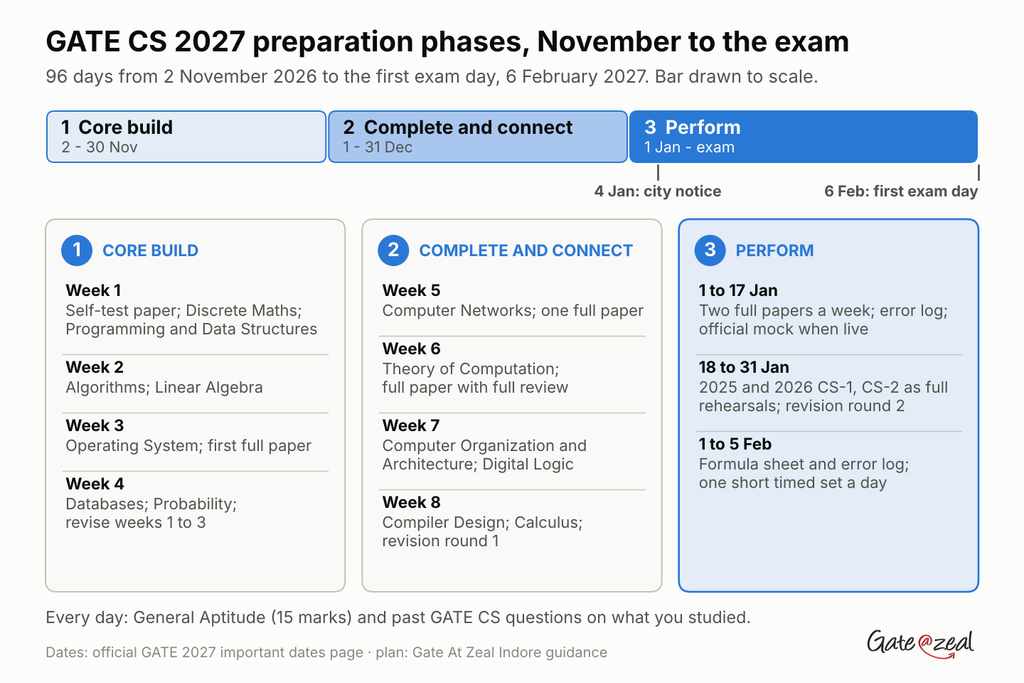
Phase plan: November 2026 to the GATE 2027 exam
This plan assumes your CS paper is on the first exam weekend. If it falls later, extend phase 3.
Phase 1: Core build (2 to 30 November)
| Week | Focus |
|---|---|
| 1 | Self-test with one timed past CS paper; Discrete Mathematics; Programming and Data Structures |
| 2 | Algorithms; Linear Algebra |
| 3 | Operating System; first full timed paper on the weekend |
| 4 | Databases; Probability; quick revision of weeks 1 to 3 |
Phase 2: Complete and connect (1 to 31 December)
| Week | Focus |
|---|---|
| 5 | Computer Networks; one full paper |
| 6 | Theory of Computation; one full paper with full review |
| 7 | Computer Organization and Architecture; Digital Logic |
| 8 | Compiler Design; Calculus; revision round 1 of all subjects |
By the end of December, every section should be studied at least once, or consciously marked as light.
Phase 3: Perform (1 January to your exam)
| Period | Focus |
|---|---|
| 1 to 17 January | Two full papers a week; error-log revision; city notice on 4 January; official mock when live |
| 18 to 31 January | Most recent CS papers (2025 and 2026, CS-1 and CS-2) as full rehearsals; revision round 2 |
| 1 to 5 February | Formula sheet and error log only; one short timed set a day; admit card check |
Every day in all three phases: General Aptitude practice and past GATE CS questions on whatever you studied. Our how to prepare for GATE in 3 months guide has daily timetables you can pair with this plan.
Previous year papers and mocks for GATE CS 2027
What the official download page offers
The official GATE 2027 download page has a bulk download of question papers from 2007 to 2026, and year-wise papers with official answer keys from 2021 to 2026. For CS, it lists CS-1 and CS-2 for 2024, 2025 and 2026, and a single CS paper for 2023, each with its answer key.
How to use them in your strategy
| Stage | Use |
|---|---|
| While studying a subject | Solve every past CS question on that subject, topic-wise |
| From week 3 | One full timed paper a week, older years first |
| January | The most recent papers (2025 and 2026, CS-1 and CS-2) as full rehearsals |
Before relying on an old question, check its topic against the revised GATE 2027 CS syllabus. Our guide on GATE previous year question papers explains the three-pass method and self-scoring with official keys.
Mock tests
- Full-length CS mocks add fresh questions. Take them weekly in December and twice a week in January, mixed with past papers.
- The official GATE mock shows the real screen, question palette and virtual calculator. Use it as soon as it is live, and again near the exam. See our GATE 2027 mock test guide.
Review every paper
After each paper, tag every lost mark as a concept gap, calculation slip, misread, wrong guess or time-out, and fix the biggest group first. Our guide on how to analyse GATE CSE mock tests shows the full method.
Exam-day strategy for the GATE CS paper
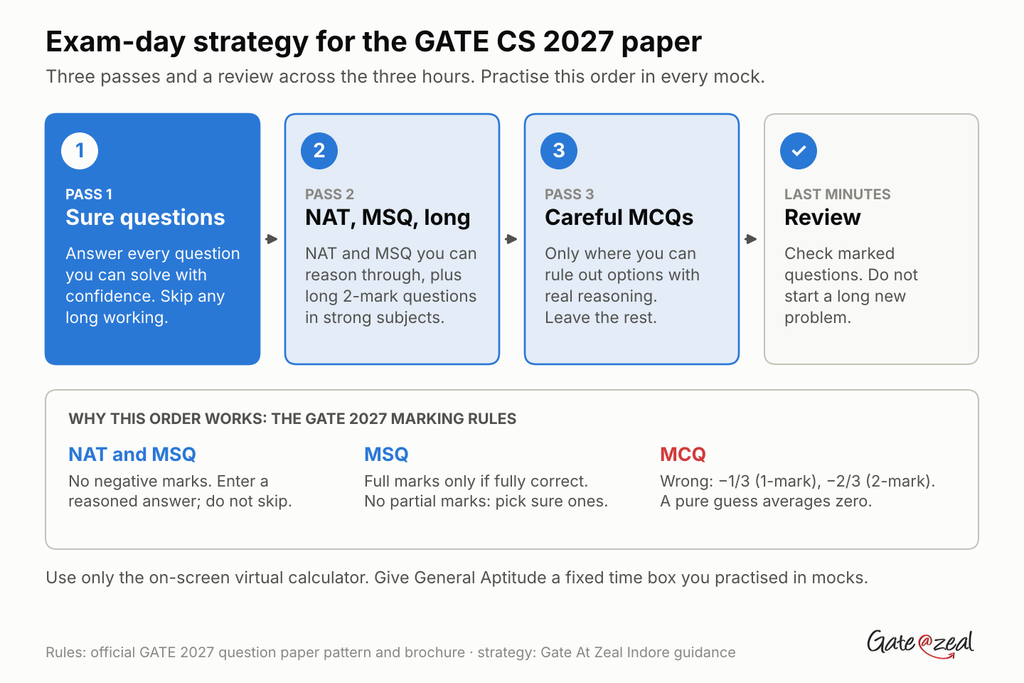
The last part of a GATE CS 2027 preparation strategy is how you use the three hours. Practise this order in every mock so it is automatic on the day.
A three-pass attempt
- Pass 1, sure questions: go through the paper and answer every question you can solve with confidence. Skip anything that needs long working.
- Pass 2, longer questions: return to NAT and MSQ questions you can reason through, and the longer 2-mark questions in your strong subjects.
- Pass 3, careful MCQs: attempt MCQs only where you can rule out options with real reasoning.
- Last minutes: review marked questions; do not start a long new problem.
Use the marking rules
- NAT and MSQ carry no negative marks. If you have worked out a reasonable answer, enter it.
- MSQ gives no partial marks. Select options only when you are sure of each one.
- Wrong MCQs cost 1/3 or 2/3 of a mark. A pure guess on four options has an expected value of zero; guessing helps only after you rule some options out.
Virtual calculator and scribble pad
The brochure says “A virtual scientific calculator will be available on the computer screen” and candidates must use only that. Practise with an on-screen calculator in mocks so long calculations do not slow you down. A scribble pad is given for rough work; keep your working neat enough to recheck.
Timing and entry
You may be seated 40 minutes before the start, log in from 20 minutes before, and cannot log in after 15 minutes past the start. Carry the printed admit card and the original valid photo ID you used in your application. Mobile phones, watches and calculators are prohibited in the hall.
Mistakes CS aspirants make
- Planning from an old syllabus. The GATE 2027 syllabi were revised. Use the official GATE 2027 CS PDF as your master list.
- Watching lectures without solving. CS questions test application. Solve past questions on every topic the same day.
- Leaving Engineering Mathematics for later. Discrete maths feeds into Algorithms, Theory of Computation and Databases; delaying it makes those harder.
- Ignoring General Aptitude. It is 15 marks in every paper, the same for every candidate.
- Reading code instead of tracing it. Programming questions need you to run code by hand, line by line.
- No formula sheet for numerical topics. Cache, pipelining, scheduling, paging and network delays all need fixed methods you can recall quickly.
- Starting full papers too late. Begin by the third week; CS papers need stamina across ten different sections.
- Using the newest papers too early. Keep the 2025 and 2026 CS-1 and CS-2 papers for January rehearsals.
- Skipping the review. A mock without an error log only gives a score.
- Leaving NAT and MSQ blank. They have no negative marks; a reasoned answer never costs you.
Frequently asked questions
What is the best GATE CS 2027 preparation strategy?
Plan from the revised GATE 2027 CS syllabus, build the core subjects first, solve past GATE CS questions topic-wise as you study, take full timed papers weekly from December and twice a week in January, and practise General Aptitude every day.
How many sections are in the GATE 2027 CS syllabus?
Ten: Engineering Mathematics, Digital Logic, Computer Organization and Architecture, Programming and Data Structures, Algorithms, Theory of Computation, Compiler Design, Operating System, Databases and Computer Networks.
Has the GATE CS syllabus changed for 2027?
The official GATE 2027 site says the syllabi for the GATE 2027 test papers have been revised and advises candidates to check the updated syllabi. Use the official GATE 2027 CS syllabus PDF as your reference.
How many marks is General Aptitude in GATE CS 2027?
General Aptitude carries 15 marks and is common to all papers. The remaining 85 marks cover the CS syllabus, for a total of 100.
Which subjects should I start with for GATE CS 2027?
Most aspirants do well to start with Engineering Mathematics (especially discrete maths), Programming and Data Structures, Algorithms and Operating System, then confirm the order against their own count of recent past papers.
When is the GATE CS 2027 exam?
GATE 2027 runs on 6, 7, 13, 14, 20 and 21 February 2027. The paper-wise schedule, including the CS date, has not been announced yet, as of 2 November 2026.


