
Alongside the GATE 2027 notification, IIT Madras made one announcement that changes actual day-to-day preparation more than any date or fee update could: the GATE 2027 syllabus revised across several papers, and a completely new paper — Robotics & Automation (RA) — was added to the GATE lineup for the first time. If you’ve been studying from last year’s syllabus PDF, or you’re deciding whether a second paper is worth adding to your application, this is the update that actually affects what you sit down and study every day.
This guide breaks down exactly what’s new in the GATE 2027 syllabus: which branches have real topic-level changes, which ones are untouched, how the XE/XH/XL multi-section papers have been restructured, and a full explanation of the new Robotics & Automation paper — its structure, its topics, and who should genuinely consider it. We’ve put this together at Gate At Zeal Indore the way we’d explain it to a student sitting across the table from us, because a syllabus revision like this is exactly the kind of change that quietly costs candidates marks when it’s ignored.
GATE 2027 Syllabus Revised: The Big Picture
Before getting into branch-wise detail, here’s what actually changed at a structural level in the GATE 2027 syllabus:
- A new paper — Robotics & Automation (RA) — has been introduced, bringing together mechatronics, robotics, and automation into a standalone test paper for the first time.
- Textile Engineering (TF) is no longer a standalone paper; it has been folded into the Engineering Sciences (XE) paper as a new optional section, XE9.
- Several core papers — including Computer Science (CS), Mechanical Engineering (ME), Civil Engineering (CE), Electronics & Communication (EC), Data Science & Artificial Intelligence (DA), Biotechnology (BT), and Instrumentation Engineering (IN) — have topic-level additions, deletions, or rewordings.
- Electrical Engineering (EE) has no substantive syllabus changes for GATE 2027 — all sections and topics remain the same as the previous cycle.
- The multi-section papers (XE, XH, XL) have revised compulsory sections and restructured optional-section marks distribution.
The overall exam pattern hasn’t changed: every GATE 2027 paper is still worth 100 marks, with General Aptitude (GA) contributing a common 15 marks and the remaining 85 marks split between Engineering Mathematics and your core subject, in a 3-hour computer-based test with MCQ, MSQ, and NAT questions. What’s changed is the content inside that 85-mark subject block — and for several branches, that content has shifted meaningfully.
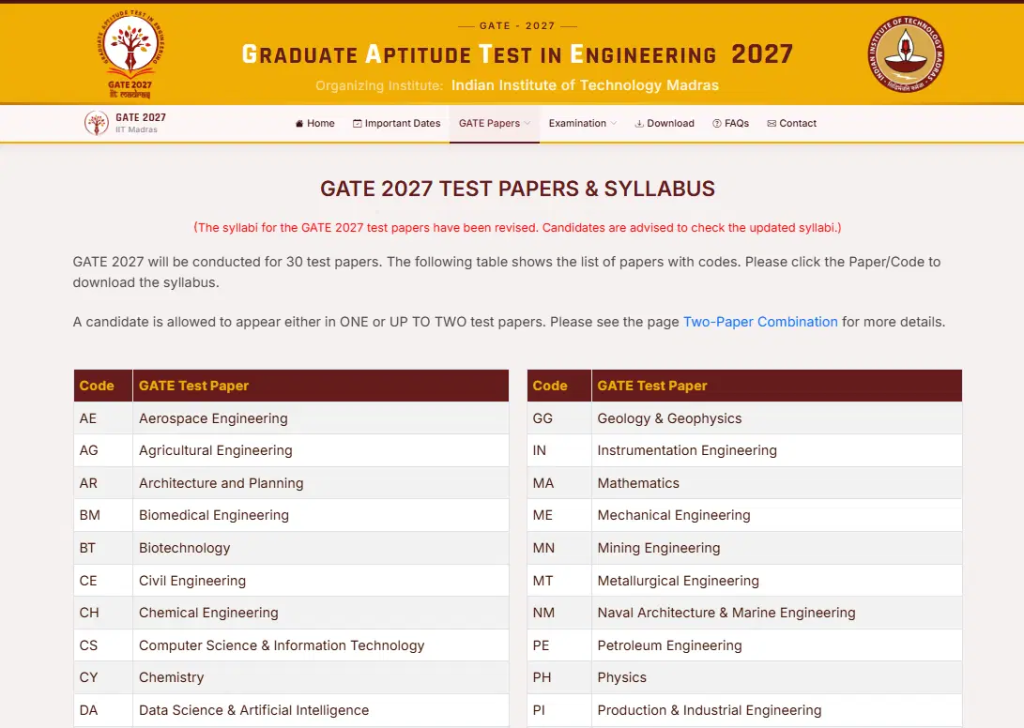
Since IIT Madras has revised the official information brochure more than once after the initial GATE 2027 notification, treat this article as your branch-wise map of what changed — but always cross-check the exact wording against the latest syllabus PDF on gate2027.iitm.ac.in before finalising your study plan, since brochure versions have already been updated once (from v1 to v1.1) and could see further clarifications.
Also Read: Top Mistakes Students Make in GATE Preparation (And How to Avoid Them)
GATE 2027 Syllabus Changes: Branch-Wise Breakdown
GATE 2027 Computer Science & IT Syllabus Changes
For CS/IT aspirants — the largest group we work with at Gate At Zeal Indore — three subjects carry real changes in the GATE 2027 syllabus, while the rest are untouched:
Digital Logic. Minimisation techniques are now explicitly named rather than grouped generically — algebraic minimisation, Karnaugh Maps (K-Maps), and tabular methods are each called out. Design of combinational and sequential circuits is now stated as its own distinct learning objective rather than being implied within broader topics.
Computer Organisation & Architecture (COA). The syllabus now explicitly splits control unit design into two distinct areas — hardwired design and microprogrammed design — rather than treating “control unit design” as one block. Cache memory mapping concepts have been added as an explicit topic. To balance this, direct mentions of main and secondary storage as standalone topics have been removed (though they remain relevant as background context).
Computer Networks (CN). This subject has been trimmed rather than expanded. The OSI model stack as an explicit topic, along with basic IP support protocols (ARP, DHCP, ICMP), have been removed from the syllabus. The application layer section is now narrower too, effectively covering just DNS and HTTP rather than a broader list of protocols.
What’s unchanged: Algorithms, Programming & Data Structures, Operating Systems, Databases, Theory of Computation, Compiler Design, and Engineering Mathematics remain the same as previous cycles. If you’ve already built a strong base in these six areas, that preparation carries forward directly into GATE 2027.
Data Science & Artificial Intelligence (DA) — the newer sibling paper to CS, popular with students choosing between core CS and DS/AI-flavoured roles — has also seen adjustments broadly in step with the CSE-side changes, so DA aspirants should review the same three areas (logic/architecture-adjacent topics and networking-adjacent content) against the updated syllabus PDF.
GATE 2027 Mechanical, Civil & Electronics Syllabus Changes
Mechanical Engineering (ME), Civil Engineering (CE), and Electronics & Communication Engineering (EC) each carry topic-level additions, deletions, or rewordings in the GATE 2027 syllabus revision, though the changes are more incremental than structural — largely refinements and rebalancing within existing sections rather than entirely new sub-topics. If you’re preparing for any of these three papers, the safest approach is a side-by-side comparison of the GATE 2026 and GATE 2027 syllabus PDFs for your specific paper, since the changes tend to be topic-specific rather than sweeping.
Electrical Engineering (EE) is the one major branch with no substantive changes this cycle — all ten sections and their listed topics carry over exactly as they were. If you’re an EE aspirant who already has GATE 2026-aligned material, it remains fully valid for GATE 2027.
GATE 2027 Biotechnology (BT) and Instrumentation Engineering (IN) Changes
These two papers saw some of the more specific, topic-level additions in this year’s revision:
Biotechnology (BT): New additions include Bayesian statistics and vector calculus (gradient, divergence, curl) within Engineering Mathematics; a deeper treatment of metabolism, immunology, and microbiology within General Biology; and, within Recombinant DNA Technology, new topics such as recombination-based cloning, biosensors, and omics tools.
Instrumentation Engineering (IN): Major additions include tensors and Bayes’ theorem in the mathematics-adjacent sections, neural-network backpropagation, Maxwell’s equations, batteries and solar cells, and coupled inductors.
Both of these read like genuine modernisation — pulling in concepts (Bayesian methods, neural networks, omics tools) that reflect where research and industry have moved, rather than cosmetic rewording.
Also Read: Why GATE At Zeal Is the Best Choice for GATE CSE Preparation
XE, XH & XL: Restructured Multi-Section Papers
The three multi-section papers have also been reorganised as part of the GATE 2027 syllabus revised update:
| Paper | What Changed |
|---|---|
| XE — Engineering Sciences | Textile Engineering & Fibre Science (previously the standalone TF paper) is now XE9, a selectable optional section. Engineering Mathematics remains compulsory (15 marks), with two optional sections chosen from the available list, each worth 35 marks (70 marks total). |
| XH — Humanities & Social Sciences | XH0 (Reasoning and Comprehension) is now the compulsory common section, worth 25 marks, with the remaining marks distributed across chosen optional sections. |
| XL — Life Sciences | XL0 (Chemistry) is now the compulsory section, worth 25 marks, followed by two optional sections of 30 marks each. |
If you were planning to take XE, XH, or XL, don’t assume your section choice from last year’s syllabus still maps cleanly onto GATE 2027 — check the updated section list and codes directly, since a few sections have been added, removed, or rearranged.
Robotics & Automation (RA): GATE’s Newest Paper Explained
The single biggest talking point in the GATE 2027 syllabus revised announcement is the introduction of Robotics & Automation (RA) as a standalone test paper — GATE’s first dedicated paper covering robotics, mechatronics, and industrial automation as a unified subject, rather than scattered across ME, EE, and EC electives.
Why RA Was Introduced
Robotics, automation, and mechatronics have grown from niche specialisations into core hiring areas across manufacturing, automotive, warehousing, and advanced research — and GATE’s paper list has historically lagged slightly behind exactly this kind of interdisciplinary, industry-driven shift. RA is IIT Madras’s response: a single paper that lets candidates with a genuine robotics/automation background demonstrate that specialisation directly, instead of approximating it through a general mechanical or electrical paper.
GATE 2027 RA Paper Structure
The RA paper is built differently from GATE’s traditional single-syllabus papers — it has a compulsory core plus a choice of specialisation:
| Section | Marks | Content |
|---|---|---|
| General Aptitude (GA) | 15 | Common to all GATE papers |
| Part A (compulsory) | 60 | Engineering Mathematics + Basics of Mechatronics + Principles of Robotics and Automation |
| Part B (choose one) | 25 | B1: Electrical Engineering stream, or B2: Mechanical Engineering stream |
| Total | 100 |
Candidates choose their Part B stream — Electrical or Mechanical — during the exam itself, which means you can prepare both broadly and decide based on which set of questions suits you better on exam day, though most candidates will naturally lean toward whichever stream matches their academic background.
Also Read: Best GATE Coaching in Indore – Complete Guide
Key Topics in RA Part A
The compulsory Principles of Robotics and Automation section covers genuinely hands-on robotics fundamentals, including:
- Robot classification — serial and parallel manipulators, geometrical configuration
- Links, joints, coordinate systems, and degrees-of-freedom (DOF)
- Rotation matrices in 2D and 3D, homogeneous transformations, and forward kinematics
- Robot applications — point-to-point and continuous-path control
- Types of end-effectors, and robot accuracy and repeatability
Alongside this, Basics of Mechatronics and the compulsory Engineering Mathematics section round out Part A’s 60 marks.
RA Part B: Electrical vs Mechanical Stream
- Part B1 (Electrical Engineering stream) leans into circuits, embedded systems, signals, and control — a natural fit for EE/EC-background candidates or CS candidates with strong embedded-systems exposure.
- Part B2 (Mechanical Engineering stream) covers mechanics, dynamics, design, and manufacturing — better suited to ME-background candidates.
Who Should Consider the RA Paper
RA is designed for candidates with genuine interest and academic exposure to robotics, automation, mechatronics, embedded systems, or control engineering — not as an “easier alternative” to a core branch paper. If your coursework, projects, or interests already sit at the intersection of mechanical systems, electronics, control theory, and embedded computing, RA lets you demonstrate that directly to M.Tech admission committees and PSU recruiters who value that specialisation.
Eligibility follows the same relaxed GATE 2027 rule as every other paper — graduates or final-year students of an eligible engineering/technology/science programme, and now also third-year B.Tech students under the 10+2+3 (ongoing) relaxation, can appear for RA.
Can You Pair RA With Your Core Branch?
Yes — RA has been built as a combinable paper. Based on the official permitted combinations, RA can be paired with EE, ME, DA, or CS as a second paper, subject to the exact combination rules in the official brochure. This is a meaningful option for CS or DA students at Gate At Zeal Indore who have a genuine robotics/automation interest (say, through embedded systems or applied AI in robotics) and want a second paper that’s differentiated rather than overlapping with their core preparation.
How the GATE 2027 Syllabus Revision Should Change Your Prep
A syllabus revision isn’t just an administrative footnote — it should directly reshape your study plan:
- If you’re CS/IT: Don’t assume your existing Digital Logic, COA, and Computer Networks notes are fully current. Specifically revisit minimisation techniques (all three methods), the hardwired-vs-microprogrammed control unit split, cache mapping, and the narrowed application-layer scope in Computer Networks. Your Algorithms, DS, OS, and DBMS preparation carries over unchanged.
- If you’re ME, CE, or EC: Do a line-by-line comparison of your paper’s updated syllabus PDF against what you’ve already studied — the GATE 2027 syllabus revised changes here are incremental, so most of your existing prep remains valid, but a few topics may need fresh attention.
- If you’re EE: Your existing preparation is fully aligned with GATE 2027 — no syllabus-driven changes to account for.
- If you’re BT or IN: Budget real time for the new topics (Bayesian statistics, omics tools, and recombination-based cloning for BT; tensors, neural-network backpropagation, and Maxwell’s equations for IN), since these are genuinely new additions, not rewordings of existing content.
- If you’re considering a second paper: Evaluate RA on its own merits — a genuine interest in robotics/mechatronics, not just as a “safe” combination — before committing, since Part A’s kinematics and mechatronics content requires real, focused preparation of its own.
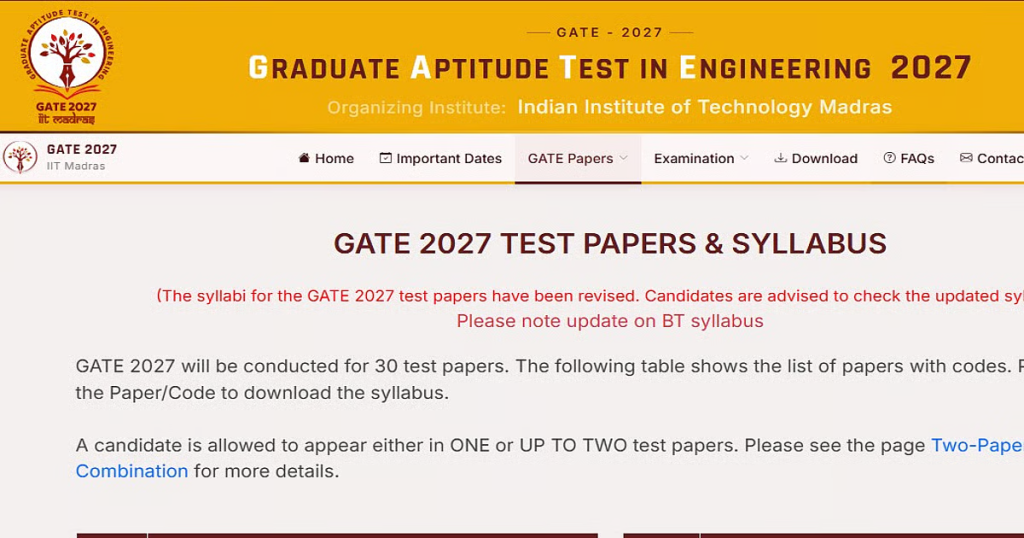
Where to Find the Official GATE 2027 Syllabus
Always work from the primary source rather than a third-party summary (including this one) for your final revision checklist:
- Official syllabus and papers page: gate2027.iitm.ac.in/exam_papers_and_syllabus
- Official information brochure (IB): available as a downloadable PDF from the same site — check the version number, since IIT Madras has already issued at least one brochure revision after the original GATE 2027 notification.
Cross-referencing the brochure PDF directly takes ten minutes and removes any doubt about whether a secondary source (again, including this article) has summarised a topic correctly.
How Gate At Zeal Indore Is Adapting to the GATE 2027 Syllabus Revision
A syllabus revision this significant is exactly the moment where generic, recycled study material starts to show its age. At Gate At Zeal Indore, our CS/IT-focused faculty — industry experts and former GATE toppers — have been mapping the GATE 2027 syllabus revised changes directly into updated study material and test series questions, so students aren’t left decoding brochure PDFs on their own while trying to prepare.
Concretely, that means:
- Updated CS/IT material that reflects the revised Digital Logic, COA, and Computer Networks scope — not last year’s notes with a new cover page.
- Guidance on RA as a second paper, for CS and DA students genuinely curious whether pairing it with their core subject makes sense for their target M.Tech programme or PSU role.
- A test series recalibrated to current weightage, so your mock scores reflect GATE 2027’s actual syllabus rather than an outdated one.
- Small batches and direct faculty access, so syllabus-specific doubts — “is this topic still in scope?” — get answered quickly rather than left to guesswork.
If the syllabus revision has left you unsure whether your current material is still accurate, that’s worth resolving early rather than late. Explore Gate At Zeal’s GATE coaching in Indore or their online GATE CS coaching to get syllabus-aligned guidance before your preparation goes too far down the wrong path.
Quick Recap: GATE 2027 Syllabus Changes at a Glance
If you only take one thing away from this article, let it be this summary — bookmark it and come back to it as you revise:
- New paper: Robotics & Automation (RA), combinable with EE, ME, DA, or CS.
- Merged paper: Textile Engineering (TF) is now XE9 within Engineering Sciences, not a standalone paper.
- Revised (topic-level changes): CS/IT (Digital Logic, COA, Computer Networks), DA, ME, CE, EC, BT, IN.
- Unchanged: Electrical Engineering (EE) — no substantive syllabus changes.
- Restructured: XE, XH, and XL multi-section papers now have different compulsory sections and mark distributions.
- Same overall pattern: 100 marks per paper, GA 15 marks, 3-hour CBT with MCQ/MSQ/NAT questions.
Treat this as a starting checklist, not a replacement for reading your specific paper’s syllabus PDF end to end — a revision like this rewards candidates who actually verify their prep against the source document rather than assuming last year’s notes still apply everywhere.
FAQs: GATE 2027 Syllabus Revision & Robotics & Automation
What are the major changes in the GATE 2027 syllabus? The two biggest changes are the introduction of a new Robotics & Automation (RA) paper and topic-level revisions across CS, ME, CE, EC, DA, BT, and IN, along with a restructuring of the XE, XH, and XL multi-section papers. Electrical Engineering (EE) has no substantive changes.
Has the GATE 2027 CS syllabus changed? Yes, in three areas: Digital Logic (minimisation techniques and circuit design now explicit), Computer Organisation & Architecture (hardwired vs microprogrammed design split, cache mapping added), and Computer Networks (OSI stack and several IP protocols removed, application layer narrowed to DNS/HTTP). Algorithms, Programming, DS, OS, and Databases remain unchanged.
Is Robotics & Automation a good second paper for CS students? It can be, if you have genuine interest or project exposure in embedded systems, mechatronics, or applied robotics — RA can be officially paired with CS as a two-paper combination. It’s not a shortcut, though; Part A’s kinematics and mechatronics content needs dedicated preparation of its own.
Which GATE 2027 papers have no syllabus change? Electrical Engineering (EE) carries no substantive changes for GATE 2027 — all ten sections remain as they were. Several individual topics within other papers (like Algorithms and Operating Systems in CS) are also unchanged even where their paper overall was revised.
Can I pair Robotics & Automation with my core engineering paper? Yes — RA can be combined with EE, ME, DA, or CS as a permitted two-paper combination, based on the official GATE 2027 brochure. Confirm the exact combination rules before selecting this on your application form.
Where can I get GATE 2027 study material aligned to the revised syllabus in Indore? Gate At Zeal Indore has updated its GATE CS/IT material and test series to reflect the GATE 2027 syllabus revision, with faculty guidance available on whether Robotics & Automation is a good fit as a second paper for your goals.
Conclusion: Don’t Let the GATE 2027 Syllabus Revision Catch You Off Guard
The GATE 2027 syllabus revised update is more than a routine yearly tweak — a genuinely new paper in Robotics & Automation, real topic-level changes in CS, BT, IN, and other branches, and a restructured set of multi-section papers all mean that studying from an unverified, last-year syllabus is a real risk this cycle. The fix is straightforward: check your specific paper’s updated syllabus PDF against what you’re currently studying, adjust where needed, and treat any brand-new topics (in BT, IN, or if you’re exploring RA) as genuinely new preparation rather than a light refresh.
If you’re in Indore and want your preparation mapped directly against the revised GATE 2027 syllabus — including an honest opinion on whether Robotics & Automation is worth adding as a second paper — Gate At Zeal Indore can walk through your specific branch and goals with you. Get your study plan aligned to the actual 2027 syllabus now, while there’s still runway before February.