


The wait is finally over. The GATE 2027 notification is out — IIT Madras released it officially on 20 July 2026, confirming that the online application window opens on 14 August 2026 through the GOAPS portal at gate2027.iitm.ac.in. If you’re an engineering student in Indore (or anywhere in India) planning to sit for the Graduate Aptitude Test in Engineering next year — for an M.Tech admission, a PSU recruitment, or simply to strengthen your résumé — this notification is the starting gun for your preparation timeline.
This guide covers everything that matters now that the GATE 2027 notification is out: the complete exam dates, the application window and how to fill the form correctly, the category-wise fee structure, who is eligible this year, and what has genuinely changed in the 2027 cycle. We’ll also look at how much real preparation time you have left before February 2027, and how students across Indore are using this window with structured, offline guidance from Gate At Zeal Indore.
GATE 2027 Notification Out: Key Highlights at a Glance
GATE 2027 is being jointly organised by the Indian Institute of Science (IISc) and the seven IITs, with IIT Madras as this year’s organising institute. The exam continues to serve as the gateway to M.Tech/PhD admissions at IITs, NITs, and IISc, as well as recruitment at major PSUs like ONGC, NTPC, BHEL, IOCL, and Power Grid.
Here’s a quick snapshot of everything announced in the GATE 2027 notification:
| Event | Date |
|---|---|
| GATE 2027 notification released | 20 July 2026 |
| Application window opens (GOAPS) | 14 August 2026 |
| Last date to apply — regular window | 21 September 2026 |
| Last date to apply — extended window (late fee) | 30 September 2026 |
| Admit card release | 3 January 2027 |
| GATE 2027 exam dates | 6, 7, 13, 14, 20 & 21 February 2027 |
| Result (expected, based on the usual GATE cycle) | Mid-March 2027 |
A few things stand out in this year’s notification. GATE 2027 will be held for 30 test papers — one more than last year — with a brand-new Robotics and Automation (RA) paper added to reflect where engineering hiring and research are heading. The eligibility criteria have also been relaxed, the exam will introduce live facial verification at test centres, and document verification will now run through DigiLocker. We’ll unpack each of these below, but if you only remember one thing from this section, remember this: the application window is short and the fee structure is category-specific, so it pays to plan both your form and your fee payment in advance rather than rushing in the last week of September.
Also Read: Best Test Series for GATE CSE: What to Look For and Why GATE At Zeal Leads the List


GATE 2027 Exam Dates: The Full Schedule
Mark your calendar — the GATE 2027 exam dates are spread across two consecutive weekends:
- 6 and 7 February 2027 (Saturday–Sunday)
- 13 and 14 February 2027 (Saturday–Sunday)
- 20 and 21 February 2027 (Saturday–Sunday)
The exam will be conducted as a Computer-Based Test (CBT) across designated centres in India and a handful of international cities. As in previous GATE cycles, the test is typically held in two shifts each day — a forenoon and an afternoon session — with each paper running for three hours. Which specific paper is scheduled on which date and shift is not announced with the notification itself; that detail is usually confirmed only when the admit card is released, which this year is scheduled for 3 January 2027.
This gap between “notification” and “your exact exam slot” is exactly why so many candidates get caught off guard — they know the exam is “sometime in February” but don’t plan their revision schedule around firm dates until admit cards are out, by which point there are only about five weeks left. A smarter approach is to treat 6 February 2027 as your effective deadline for syllabus completion, regardless of which of the six dates you’re actually allotted, and use the last few weeks purely for revision and mock tests.
Your exam city is chosen during the application process itself — candidates typically list two or three preferred cities in order of preference, and the final allotment is reflected on the admit card. If you’re based in Indore, listing Indore as a preferred centre (where available) or a nearby city can save you the stress of travelling right before your paper.
One more date worth flagging now: GATE scores from the 2027 cycle will remain valid for three years from the date of result declaration, so the effort you put in this cycle has a longer shelf life for PSU applications and M.Tech admissions than many candidates assume.
GATE 2027 Application Window: How and When to Register
The application window for GATE 2027 is where most of the actionable, time-bound decisions happen — and it’s open for a relatively short stretch, so it deserves a section of its own.
Key dates for the application window:
- Opens: 14 August 2026
- Closes (no late fee): 21 September 2026
- Closes (with late fee): 30 September 2026
All applications are submitted online through GOAPS — the GATE Online Application Processing System — accessible from the official website, gate2027.iitm.ac.in. There is no offline or physical application route.
Step-by-step: How to apply for GATE 2027
- Register on GOAPS using a valid, active email address and mobile number — this becomes your login for the entire admission and results cycle, so use one you check regularly.
- Fill in personal and academic details — name (exactly as per a valid photo ID), date of birth, category, and details of your qualifying degree/institution.
- Upload the required documents — a recent passport-size photograph and signature (as per the specified size and format), category certificate (SC/ST/OBC-NCL/EWS, if applicable), PwD certificate (if applicable), and proof of eligibility such as your degree certificate or a bonafide/study certificate for final-year students.
- Choose your test paper(s) — GATE 2027 allows candidates to appear for a maximum of two papers, but only from a specific list of permitted combinations listed in the official information brochure. Choose carefully, since this cannot usually be changed after the correction window closes.
- Select your preferred exam cities — list your top choices; Indore candidates should check whether Indore is listed as a centre for their chosen paper(s).
- Pay the application fee online — via net banking, credit/debit card, or UPI (see the fee structure below).
- Review and submit — download and save the confirmation page/application form for your records. You’ll need your enrolment ID for all future correspondence.
After the regular window closes on 21 September 2026, GATE typically opens a correction window for a limited set of fields (usually in October) — this is not a second registration opportunity, so it’s best to get your form right the first time rather than relying on corrections later.
A practical tip for Indore-based applicants: keep scanned copies of your documents (photo, signature, category certificate, degree/bonafide certificate) ready before 14 August 2026, in the exact format GOAPS specifies. Most application errors and last-minute panic happen because candidates start scanning and resizing documents on the last day of the window.
Also Read: How to Crack GATE CSE with Top Rank: The Complete Roadmap
Common Mistakes to Avoid in the GATE 2027 Application Window
Every year, a predictable set of errors during the application window causes avoidable stress — or worse, a rejected or incomplete form. Watch out for these:
- Mismatched name spelling across the application, photo ID, and degree certificate — even a minor mismatch can create problems at the admit card or verification stage.
- Wrong category selection — double-check SC/ST/OBC-NCL/EWS/PwD status against your current, valid certificate before selecting it, since this directly affects your fee structure.
- Choosing an invalid paper combination — GATE only permits specific pairs of papers to be taken together; picking two papers outside the approved list will cause the second choice to be rejected.
- Uploading photos/signatures in the wrong format or size — GOAPS is strict about file specifications, and this is the single most common reason applications get stuck mid-way.
- Missing the regular deadline unnecessarily — waiting until 21 September 2026 “just in case something changes” often backfires; server load spikes in the final 48 hours of any GATE application window.
- Losing the enrolment ID or confirmation page — save multiple copies (email, cloud drive, printout); you’ll need it for admit card download, result checking, and counselling.
GATE 2027 Fee Structure: Category-Wise Breakdown
The GATE 2027 fee structure is split by category and by when you apply — applying within the regular window is meaningfully cheaper than waiting for the extended window.
| Category | Regular Window (14 Aug – 21 Sep 2026) | Extended Window (22 – 30 Sep 2026) |
|---|---|---|
| Female / SC / ST / PwD | ₹1,000 per paper | ₹1,500 per paper |
| General / OBC-NCL / EWS / Foreign nationals | ₹2,000 per paper | ₹2,500 per paper |
A few important notes on the fee structure:
- The fee is charged per paper. If you opt for two test papers (from the permitted combinations), the fee is charged separately for each — so it effectively doubles.
- Fees are non-refundable under any circumstance, including withdrawal, non-appearance on exam day, or a later finding of ineligibility. There is no provision to carry the fee forward to a future cycle either.
- Payment is accepted only through the online payment gateway on GOAPS — net banking, debit/credit cards, and UPI are generally supported.
- Always download and save the fee payment receipt along with your application confirmation page.
Practically, this means a general-category candidate applying for one paper within the regular window pays ₹2,000, while a female/SC/ST/PwD candidate pays ₹1,000 for the same. Waiting until the extended window adds ₹500 regardless of category — a fee that’s easy to avoid by simply applying a few weeks earlier.
Also Read: Top Mistakes Students Make in GATE Preparation (And How to Avoid Them)
Who Is Eligible for GATE 2027?
One of the most talked-about changes in this year’s notification is the eligibility relaxation. GATE 2027 eligibility has moved from a minimum “10+2+4 (ongoing)” requirement to “10+2+3 (ongoing)” — meaning students currently in their third year of a four-year undergraduate programme can now apply, rather than having to wait until their final year.
In practical terms, you’re eligible for GATE 2027 if you fall into any of these categories:
- Currently pursuing or have completed a Bachelor’s degree in Engineering/Technology/Architecture/Pharmacy (B.E./B.Tech/B.Arch/B.Pharm), including those in the third year of a four-year programme.
- Currently pursuing or have completed a Master’s degree in any branch of Science, Mathematics, Statistics, Computer Applications, or equivalent.
- Pursuing or have completed an integrated Master’s degree programme (5-year) in Engineering/Technology, or a Dual Degree programme.
- Hold a qualification obtained through professional society examinations recognised as equivalent to a B.E./B.Tech.
There is no upper age limit for GATE — candidates of any age who meet the academic eligibility can apply. This is particularly relevant for working professionals in Indore looking to use GATE for a PSU switch or a mid-career M.Tech.
If you’re unsure whether your specific degree or year of study qualifies, the safest step is to cross-check the exact clause against the official information brochure on gate2027.iitm.ac.in before you pay the application fee, since fees are non-refundable even if an eligibility issue surfaces later.
What’s Genuinely New in GATE 2027
Beyond the usual date-and-fee update, this year’s notification carries a few structural changes worth understanding before you apply:
A new 30th paper — Robotics and Automation (RA). GATE now covers 30 test papers, with Robotics and Automation added as an independent subject for the first time. This mirrors the growing industry and research demand in automation, robotics, and applied AI, and gives students from mechanical, electronics, and CS backgrounds a more targeted paper option.
Syllabus revisions across multiple papers. Several existing papers have had their syllabi revised to stay current with evolving curricula, alongside updates to the paper codes within the XE (Engineering Sciences), XH (Humanities and Social Sciences), and XL (Life Sciences) sections.
Live facial verification at test centres. GATE 2027 introduces live facial verification as part of the identity-check process on exam day, tightening security beyond the existing photo/signature and ID checks.
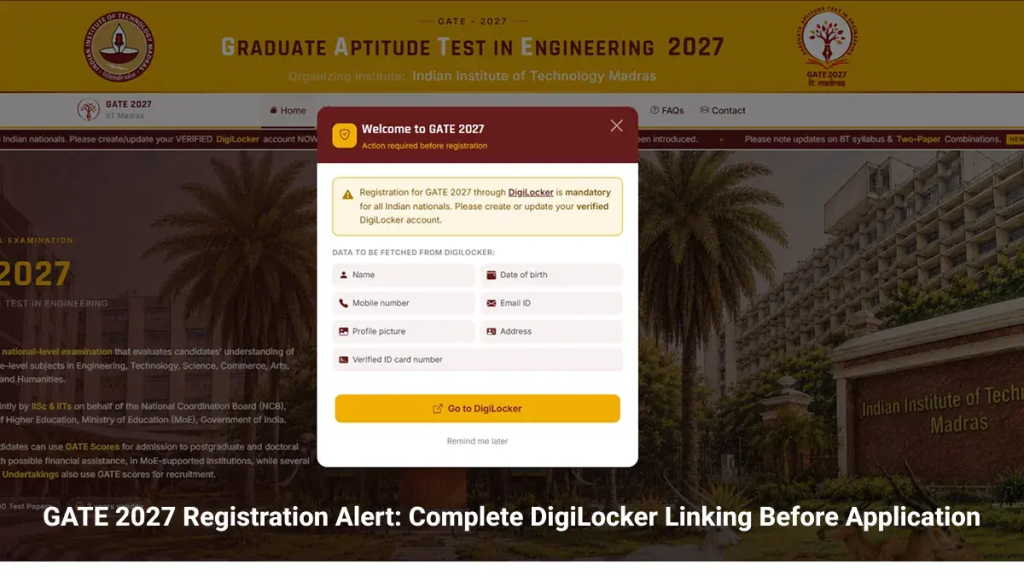
DigiLocker integration. Document verification — degree certificates, category certificates, and similar documents — will now be supported through DigiLocker, which should, in principle, make the verification process faster and reduce document-related rejections.
Taken together, these changes suggest the exam is being modernised both in terms of subject relevance and administrative rigor. If you’re preparing for a paper affected by the syllabus revision, it’s worth downloading the updated syllabus PDF from the official site rather than relying on last year’s material.
How Much Time Do You Actually Have? (And What To Do With It)
Here’s the part most candidates underestimate. With the exam spread across 6, 7, 13, 14, 20, and 21 February 2027, and today’s date sitting in early August 2026, most GATE 2027 aspirants have roughly six months from the notification to their exam date — and even less if you count backward from when you actually start focused preparation rather than from today.
Six months is enough to crack GATE with a strong AIR — but only with a structured plan, not with scattered YouTube videos and half-finished PDFs. Broadly, that time needs to cover three things in parallel: finishing the application window correctly (documents, paper choice, fee, city preference), completing your core syllabus with conceptual clarity, and — critically — enough timed mock tests and previous-year papers to convert knowledge into exam-day speed and accuracy.
A Realistic Month-by-Month Roadmap to GATE 2027
| Period | Focus |
|---|---|
| August – September 2026 | Complete the GATE 2027 application window; start core syllabus for your weakest 2–3 subjects first |
| October – November 2026 | Finish remaining syllabus; begin topic-wise practice questions and short quizzes |
| December 2026 | Full syllabus revision; start full-length mock tests under timed conditions |
| January 2027 | Admit card download (from 3 January); shift almost entirely to mock tests, previous-year papers, and error-log review |
| Early February 2027 | Light revision only, formula sheets, and rest — avoid new topics in the final week before your exam date |
This kind of month-by-month structure is easy to write down and much harder to stick to alone, especially once college coursework, semester exams, or a job competes for the same hours. That gap between “knowing the plan” and “executing the plan” is exactly the gap that structured, offline coaching is built to close, and it’s where Gate At Zeal Indore fits in for students in and around the city. Gate At Zeal has built its reputation in Indore primarily around GATE Computer Science/IT coaching, while also supporting Mechanical, Electrical, and Civil aspirants with structured study material. A few things make the six-month runway to GATE 2027 more manageable with the right coaching partner:
- Faculty who are industry experts and former GATE toppers, who know exactly where the syllabus revisions (like the new RA paper and updated XE/XH/XL codes) actually matter for your specific branch.
- Small batch sizes, so doubt-clearing and one-on-one mentoring are actually possible instead of theoretical.
- Both offline classroom batches in Indore and online options, so you can choose the format that fits your schedule — including weekend batches for working professionals and final-year students juggling college.
- Structured test series aligned to the real GATE pattern (MCQ, MSQ, and NAT questions, with accurate negative marking), which is the single highest-leverage activity in the last two to three months before your exam date.
If you’re in Indore and the GATE 2027 notification has just moved your preparation from “someday” to “in six months,” it’s worth exploring Gate At Zeal’s GATE coaching programs in Indore or their online GATE CS coaching before your batch fills up — application deadlines and admission cycles for coaching batches tend to move in step with the GATE calendar itself.
FAQs: GATE 2027 Notification, Dates, Application & Fees
When will GATE 2027 be conducted? GATE 2027 will be held on 6, 7, 13, 14, 20, and 21 February 2027, as a Computer-Based Test across centres in India and select international locations.
What is the last date to apply for GATE 2027 without a late fee? 21 September 2026. Candidates who miss this can still apply until 30 September 2026 by paying the extended-window late fee.
How much is the GATE 2027 application fee? ₹1,000 per paper for Female/SC/ST/PwD candidates and ₹2,000 per paper for General/OBC-NCL/EWS/Foreign national candidates during the regular window (14 August – 21 September 2026). These rise to ₹1,500 and ₹2,500 respectively during the extended window.
Can a third-year engineering student apply for GATE 2027? Yes. This year’s notification relaxed eligibility to “10+2+3 (ongoing),” so students currently in the third year of a four-year undergraduate programme can now apply, in addition to final-year and graduated candidates.
Is there a new paper or subject added in GATE 2027? Yes — Robotics and Automation (RA) has been added as a new, 30th test paper, alongside syllabus revisions in several existing papers and updated codes within the XE/XH/XL sections.
Will GATE 2027 be more competitive because third-year students can now apply? Possibly, since the relaxed eligibility opens the exam to an additional batch of third-year students. This makes disciplined preparation and regular mock testing more important than ever — candidates who start early with a structured plan will have a real edge over those who begin closer to the exam.
Which exam city should Indore candidates choose for GATE 2027? List Indore as your first preference if it’s available for your chosen paper(s); if not, pick the nearest city with a centre to minimise travel and fatigue before your exam slot. Final city allotment is confirmed on your admit card, released from 3 January 2027.
Where can I get reliable GATE 2027 coaching in Indore? Gate At Zeal Indore offers offline classroom batches and online coaching for GATE, with a particular strength in Computer Science/IT, along with structured test series and small-batch, mentor-led guidance for other engineering branches.
Conclusion: The GATE 2027 Notification Is Out — Now the Clock Is Running
The GATE 2027 notification is out, the exam dates are locked in for February 2027, the application window opens 14 August 2026, and the category-wise fee structure rewards those who apply early rather than waiting for the extended deadline. None of these facts change how hard the exam is — but knowing them cold, well in advance, removes an entire category of avoidable stress from your preparation.
If you’re based in Indore and serious about converting the next six months into a strong GATE 2027 attempt, don’t let the application window be the only deadline you plan around. Start your syllabus, mock tests, and revision schedule now, and consider getting structured support from a coaching partner that already knows this exam inside out. Gate At Zeal Indore has been guiding GATE aspirants through exactly this kind of preparation window — reach out to their counsellors to plan your GATE 2027 roadmap before the 21 September application deadline arrives.


