

The Robotics & Automation Paper is the single biggest addition to GATE 2027 — a brand-new 31st paper with no previous-year question bank, no established cutoff history, and a genuinely different internal structure from any other GATE paper. Before you decide whether to write it, you need to understand exactly how its exam pattern works — not just what topics it covers.
Gate At Zeal Indore breaks down the GATE 2027 exam pattern for the new Robotics & Automation paper below, and what it actually means for your paper choice.
Quick answer: The Robotics & Automation (RA) paper in GATE 2027 carries 100 marks across 65 questions: 15 marks General Aptitude (common to every GATE paper), 60 marks of compulsory Part A (Engineering Maths, Mechatronics basics, Robotics & Automation principles), and 25 marks of Part B — where you choose between an Electrical stream or a Mechanical stream on exam day itself. It can be paired as a second paper with CS, Data Science & AI, EE, or ME.


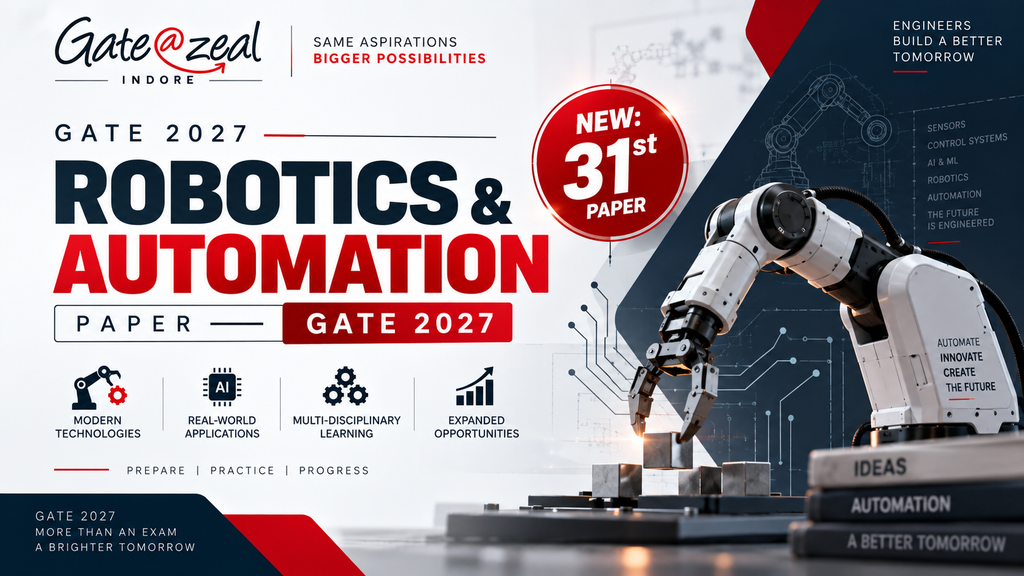
What Is the GATE 2027 Robotics & Automation Paper?
RA is the newest of GATE’s 31 papers for 2027, introduced as a standalone subject rather than a section under an existing paper. It sits deliberately at the intersection of mechanical engineering, electronics, and computing — built for candidates with exposure to embedded systems, mechatronics, or applied robotics, regardless of which core branch they studied.
Also Read: GATE 2027 New Syllabus: Branch-Wise Changes
GATE 2027 Exam Pattern: The General Rules (All Papers)
Before the RA-specific structure, here’s the gate exam pattern that applies across GATE 2027 as a whole:
| Component | Detail |
|---|---|
| Total marks | 100 |
| Total questions | 65 |
| General Aptitude | 15 marks (10 questions), common to every paper |
| Question types | MCQ, MSQ (Multiple Select), NAT (Numerical Answer Type) |
| Negative marking (1-mark MCQ) | −1/3 for a wrong answer |
| Negative marking (2-mark MCQ) | −2/3 for a wrong answer |
| Negative marking (MSQ / NAT) | None |
Robotics & Automation Paper: How the Pattern Is Different
This is where RA breaks from every other GATE paper. Instead of one fixed subject syllabus, it’s split into a compulsory core and a choice-based section:
| Section | Marks | What It Covers |
|---|---|---|
| General Aptitude | 15 | Standard GA section, same as every GATE paper |
| Part A (Compulsory) | 60 | Engineering Mathematics + Basics of Mechatronics + Principles of Robotics & Automation |
| Part B — Choose ONE | 25 | B1 (Electrical stream) or B2 (Mechanical stream) |
| Total | 100 | 65 questions |
The detail most candidates miss: you don’t have to commit to B1 or B2 when you register. You can decide which Part B stream to attempt on exam day itself, based on whichever set of questions actually suits you better once you see the paper. That flexibility is unique to RA among GATE 2027’s 31 papers.
Robotics & Automation Syllabus at a Glance
Part A (compulsory for everyone):
- Engineering Mathematics — linear algebra, calculus, differential equations, probability & statistics, numerical methods
- Basics of Mechatronics — network elements, digital circuits, sensors, actuators, engineering mechanics, basic Python and data structures
- Principles of Robotics & Automation — robot classification, coordinate systems and rotation matrices, forward kinematics, end-effectors, PLCs and CNC-based manufacturing
Part B1 (Electrical stream): Analog Circuits and Embedded Systems, Signals and Systems, Control Systems
Part B2 (Mechanical stream): Mechanics of Materials, Kinematics and Dynamics, Machine Design and Computer Integrated Manufacturing
Who Should Choose the Robotics & Automation Paper?
RA isn’t a default choice for any one branch — it’s a genuine crossover paper. It tends to suit you if:
- You’re from Mechanical, Electrical, Electronics, or Computer Science/IT with some exposure to embedded systems, mechatronics, PLCs, or robotics projects
- You’d rather sit a paper with a fresh cutoff and no historical over-competition, since RA has no previous-year data at all
- Your Part A basics (maths, mechatronics, robotics principles) are strong enough that you can pick whichever Part B stream suits you on exam day
It suits you less if your only preparation is a single core-branch syllabus with no mechatronics, embedded systems, or basic programming exposure — Part A alone assumes some multidisciplinary grounding.
Robotics & Automation as a Second Paper: What Pairs With It?
Under the GATE 2027 two-paper rule, RA can officially be combined with:
- Mechanical Engineering (ME) — the recommended pairing, given the shared kinematics and dynamics foundation
- Electrical Engineering (EE)
- Computer Science & IT (CS)
- Data Science & AI (DA)
If you’re already deep into one of these four, RA is the most natural second-paper option in GATE 2027 rather than a completely new subject to learn from scratch.
Why Consider a Brand-New Paper?
Robotics and automation as an industry has been growing steadily across manufacturing, EVs, warehousing, and defence — and GATE adding a dedicated paper reflects that direction. Because RA is new for 2027, there’s no track record yet on cutoffs, difficulty level, or exactly how competitive it will be — which cuts both ways: less certainty, but also no inflated competition built up over years like the older papers have.
How to Prepare for a Paper With No Past Papers
RA’s biggest practical challenge isn’t the syllabus — it’s that there’s no previous-year question bank to lean on. A few adjustments matter here:
- Build Part A first. It’s compulsory and covers half your marks — engineering maths, mechatronics basics, and robotics principles should be non-negotiable priorities.
- Pick a “default” Part B stream early, but stay flexible. Prepare your stronger stream (B1 or B2) as your primary plan, while keeping enough grounding in the other to switch on exam day if needed.
- Borrow practice questions from adjacent papers. Since Part B1 overlaps with EE topics and Part B2 overlaps with ME topics, mock questions from those papers’ Control Systems, Circuits, or Kinematics sections are usable practice.
- Don’t wait for “official” RA mock tests to look complete. Every coaching platform is building RA test series from scratch this year — treat all of them as first drafts, yours included.
Gate At Zeal Indore’s GATE 2027 batches include RA-specific guidance for students weighing it as a second paper alongside ME, EE, CS, or DA — including whether it’s the right call for your specific background.
Also Read: Gate At Zeal Indore — GATE 2027 Coaching
FAQ
What is the GATE 2027 Robotics & Automation paper?
It’s a new, standalone 31st GATE paper combining mechanical, electronics, and computing fundamentals, aimed at candidates with exposure to embedded systems, mechatronics, or applied robotics.
What is the exam pattern for the Robotics & Automation paper?
100 marks across 65 questions: 15 marks General Aptitude, 60 marks compulsory Part A (Engineering Maths, Mechatronics, Robotics & Automation principles), and 25 marks Part B, where you choose an Electrical (B1) or Mechanical (B2) stream on exam day.
Can I choose my Part B stream during the exam?
Yes. Unlike other GATE papers, RA lets you decide between the B1 (Electrical) and B2 (Mechanical) stream on exam day itself, based on which set of questions suits you better.
Which papers can be combined with Robotics & Automation in GATE 2027?
RA can be taken as a two-paper combination with Mechanical Engineering (recommended), Electrical Engineering, Computer Science & IT, or Data Science & AI.
Is there negative marking in the Robotics & Automation paper?
Yes, following the standard GATE 2027 scheme: −1/3 mark for a wrong 1-mark MCQ, −2/3 mark for a wrong 2-mark MCQ, and no negative marking on MSQ or NAT questions.
Conclusion
The Robotics & Automation Paper isn’t just a syllabus addition to GATE 2027 — its exam pattern itself works differently from every other paper, with a compulsory core and an exam-day choice between two specialization streams. Whether that flexibility works in your favour depends entirely on how solid your Part A fundamentals are.
If you’re weighing RA against a traditional second paper, Gate At Zeal Indore can help you make that call based on your actual background, not just the syllabus on paper.