

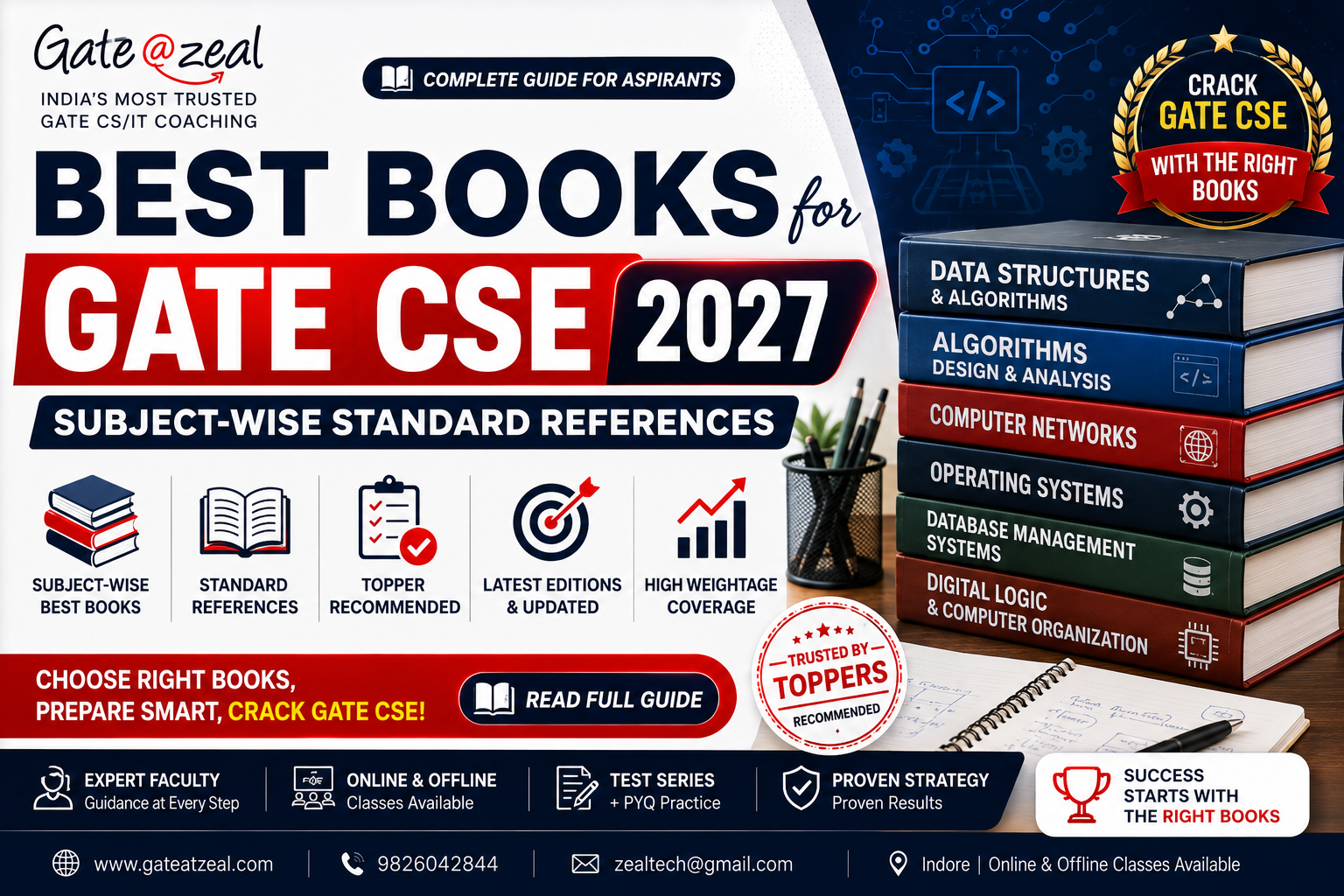
Choosing the right books is one of the most important decisions you will make in your GATE preparation journey. A wrong book can waste months of your time, fill your head with unnecessary topics, and reduce your confidence. A right book, on the other hand, can simplify the toughest concepts, sharpen your problem-solving skills, and take you straight to a top GATE rank.
Every year, lakhs of CSE students start their preparation. Most of them ask the same question — “What are the Best Books for GATE CSE 2027?” The market is flooded with books, guides, summaries, and crash courses. Some are written by professors, some by previous toppers, some by random authors, and some are just compilations of old questions. As a serious GATE 2027 aspirant, you cannot afford to pick the wrong ones.
At Gate At Zeal Indore, we have guided thousands of students through their GATE journey. Our faculty has carefully reviewed almost every popular book in the market and selected the ones that actually work. In this blog, we will share the Best Books for GATE CSE 2027, subject by subject, in very simple words. We will tell you which book to pick, why to pick it, how to use it, and when to use it. By the end of this blog, you will have a complete reading list and a clear strategy.
Let us begin.
Why the Right Books Matter So Much in GATE Preparation
Before we list the books, it is important to understand why book selection is so critical for GATE 2027.
First, GATE is a concept-based exam. It does not test memorization. It tests how deeply you understand each subject. Only standard, well-written books teach concepts in the depth GATE expects.
Second, time is limited. You have only 10 to 14 months of focused preparation. If you waste even one month on a wrong book, your entire plan suffers. The Best Books for GATE CSE 2027 are the ones that give you maximum learning in minimum time.
Third, GATE questions often come straight from standard textbooks. Many examiners are professors from IITs and IISc, and they take inspiration from the books they teach with — which are usually the same standard references that we recommend at Gate At Zeal Indore.
Fourth, good books build confidence. When you study from a respected source, you trust your knowledge. This confidence helps you perform better under exam pressure.
Now, let us go subject by subject.
Also Read: GATE 2027 Notification, Registration Dates & Eligibility — Latest Update
Subject 1 — Engineering Mathematics
Engineering Mathematics carries around 13 marks in GATE CSE, which makes it the second-most weightage-heavy section after the core CS subjects. The right books here can give you guaranteed marks.
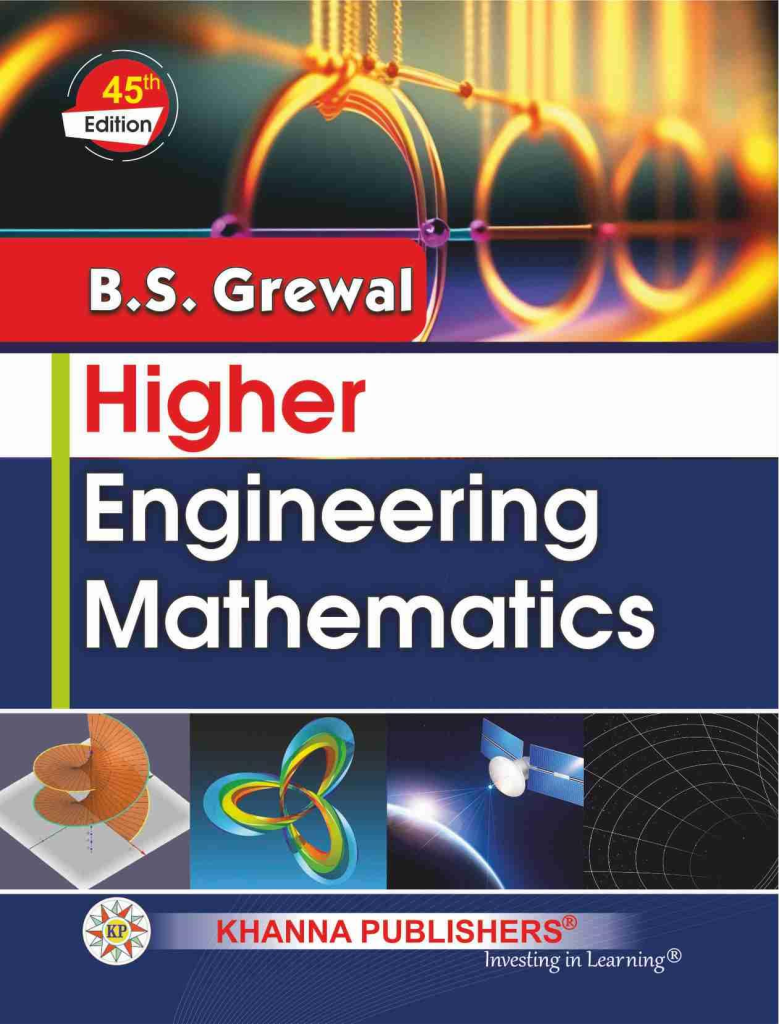
Recommended Book 1 — Higher Engineering Mathematics by B.S. Grewal
This book is a classic and one of the most trusted resources for engineering students in India. It covers Linear Algebra, Calculus, Differential Equations, and many other topics in great depth. The language is simple, and there are plenty of solved examples and exercises.
Recommended Book 2 — Advanced Engineering Mathematics by Erwin Kreyszig
This is a more advanced book and is preferred by students aiming for top ranks. It explains topics like Linear Algebra, Probability, and Numerical Methods with mathematical rigor. Use it as a backup when you want deeper understanding.

Recommended Book 3 — Probability and Statistics by Sheldon Ross or Gupta and Kapoor
For the Probability and Statistics portion, Sheldon Ross is a globally respected book. If you want a more Indian context with simpler explanations, S.C. Gupta and V.K. Kapoor’s book is also excellent.
How to use: Cover B.S. Grewal first for breadth. Move to Kreyszig for selected hard topics. Use Sheldon Ross only for Probability. Do not try to read all three end to end — that is a waste of time.
Also Read: Should I Retake GATE 2027? | Honest Guide for Students Who Got Low Rank
Subject 2 — Discrete Mathematics
Discrete Maths is the most important Maths topic for CSE students. It contributes 4 to 6 marks directly and indirectly supports many other subjects like Algorithms, TOC, and DBMS.
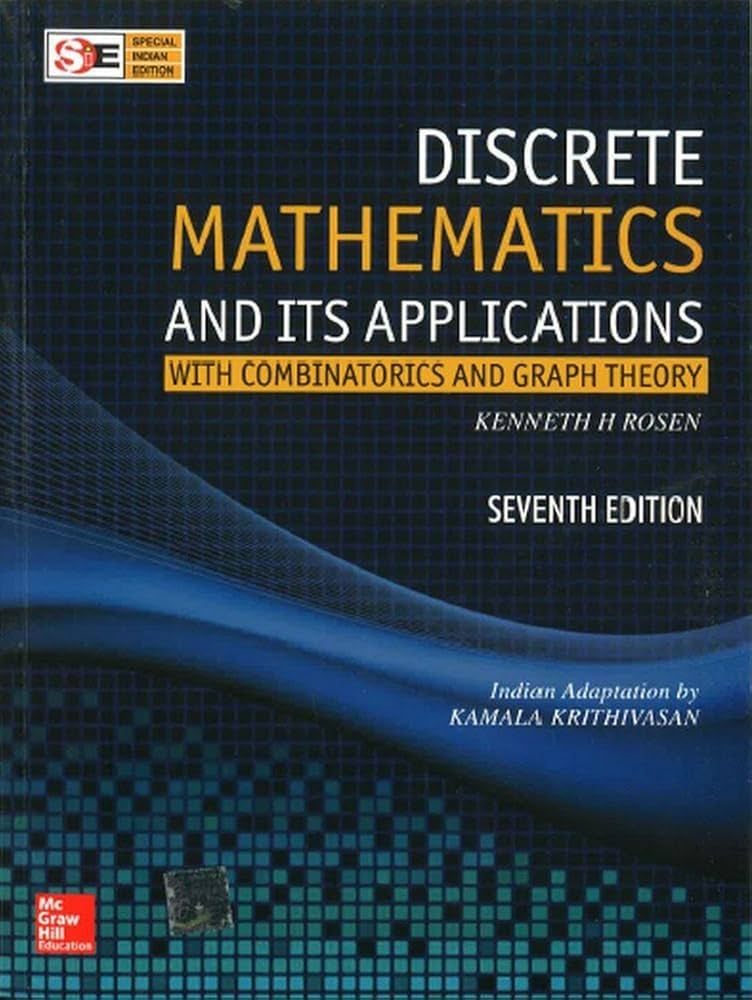
Recommended Book 1 — Discrete Mathematics and Its Applications by Kenneth H. Rosen
This is the gold standard book for Discrete Maths. It covers Propositional Logic, Set Theory, Relations, Functions, Combinatorics, Graph Theory, and Number Theory in a very clear manner. The examples are practical and the exercises range from easy to challenging.

Recommended Book 2 — Discrete Mathematics by C.L. Liu
This is another respected book, especially good for Combinatorics and Counting Techniques. Many GATE counting questions are inspired by problems in Liu’s book.
How to use: Stick with Rosen as your primary book. Use Liu only when you want extra practice in Combinatorics. Solve every solved example by hand before attempting the unsolved exercises.
The toppers at Gate At Zeal Indore have repeatedly told us that mastering Rosen alone is enough to score full marks in Discrete Maths.
Also Read: COAP 2026 Registration Guide | Step by Step for GATE CS Qualifiers
Subject 3 — Digital Logic
Digital Logic is a small subject carrying around 5 to 7 marks, and it is one of the easiest subjects to master in GATE 2027.
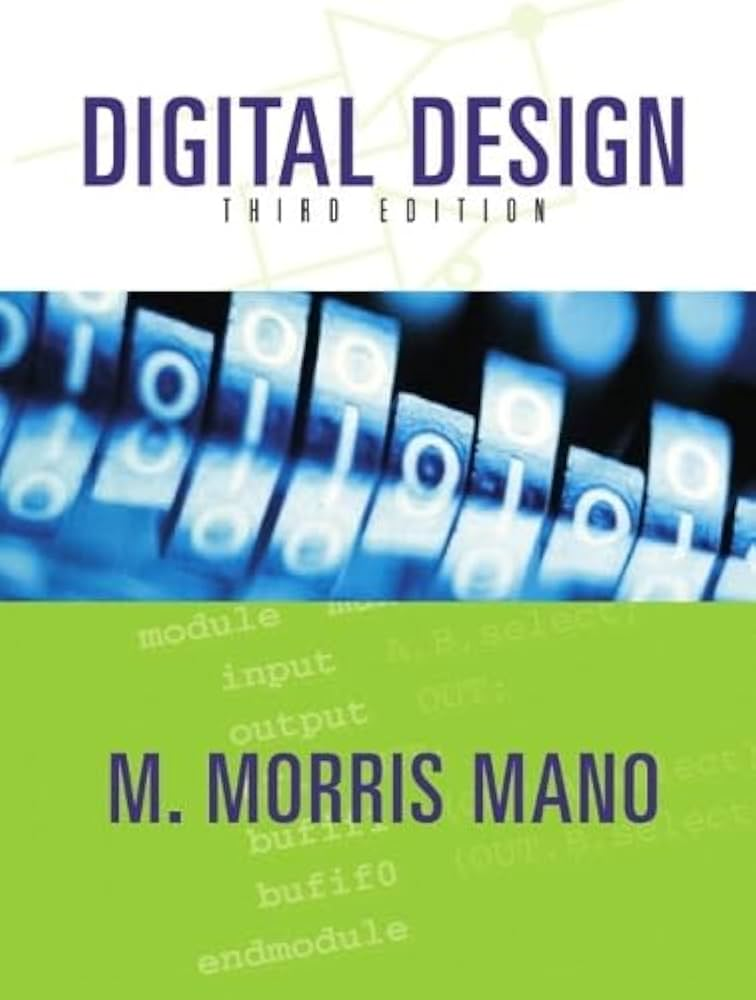
Recommended Book 1 — Digital Design by M. Morris Mano
This is the most widely used Digital Logic book in India. It explains Boolean Algebra, K-Maps, Combinational Circuits, Sequential Circuits, Flip-Flops, and Counters in a step-by-step manner. The diagrams are clear and the examples are exam-friendly.


Recommended Book 2 — Switching and Finite Automata Theory by Zvi Kohavi
This book is for students who want more advanced coverage, especially for sequential circuits. It is not mandatory, but it is helpful if you face tricky GATE questions.
How to use: Mano covers 95% of GATE Digital Logic. Read it once, solve all chapter-end exercises, and then move to PYQs. That is enough to lock in full marks.
Subject 4 — Computer Organization and Architecture (COA)
COA is a heavyweight subject carrying around 7 to 10 marks. The right book here can save you a lot of confusion, especially in topics like Pipelining and Cache Memory.
Recommended Book 1 — Computer Organization by Carl Hamacher
Hamacher is the most preferred book at Gate At Zeal Indore. It is simple, well-organized, and explains every topic at the depth GATE expects. Addressing Modes, ALU design, Pipelining, and Memory Hierarchy are explained beautifully.
Recommended Book 2 — Computer Organization and Design by David Patterson and John Hennessy
This is a more modern and global book. It introduces the MIPS architecture and is excellent for understanding instruction-level concepts. Use it for deeper coverage of Pipelining and Caching.
Recommended Book 3 — Computer System Architecture by M. Morris Mano
A solid Indian classic. Good for fundamentals and basic numerical problems.
How to use: Hamacher should be your main book. Use Patterson for Pipelining and Cache topics. Mano can be used for revision-style learning.
Subject 5 — Programming and Data Structures
This subject carries 8 to 12 marks in GATE CSE — one of the highest in the paper. You must master both C programming and core data structures to score well here.
Recommended Book 1 — Let Us C by Yashavant Kanetkar
For C programming basics, Kanetkar’s book is friendly, simple, and easy to understand. It is especially good if you are new to programming or want to revise quickly.
Recommended Book 2 — The C Programming Language by Brian Kernighan and Dennis Ritchie
Also known as the K&R book, this is the original C programming reference written by the language’s creators. The book is short but powerful. Every line teaches you something. Read it after Kanetkar.
Recommended Book 3 — Data Structures Using C by Reema Thareja
This is a simple Indian book for learning Data Structures with C implementation. It covers Linked Lists, Stacks, Queues, Trees, Graphs, and Hashing very well.
Recommended Book 4 — Data Structures and Algorithms Made Easy by Narasimha Karumanchi
This book is loved by GATE aspirants for its problem-based approach. It is great for revision and competitive-style problem solving.
How to use: Start with Kanetkar to build comfort with C. Then move to K&R for depth. For data structures, combine Reema Thareja for theory and Narasimha Karumanchi for problems. Always practice writing code by hand on paper.
Subject 6 — Algorithms
Algorithms is one of the most rewarding subjects in GATE CSE. It carries around 7 to 10 marks and overlaps with Data Structures, Mathematics, and even TOC.
Recommended Book 1 — Introduction to Algorithms by Cormen, Leiserson, Rivest, and Stein (CLRS)
This is the bible of algorithms. Every serious GATE CSE aspirant uses CLRS at least once. It covers sorting, searching, graph algorithms, dynamic programming, greedy methods, divide and conquer, complexity classes, and much more. The depth is incredible.
Recommended Book 2 — Algorithm Design by Jon Kleinberg and Éva Tardos
This is a more conceptual book that focuses on the design philosophy of algorithms. It is excellent for understanding why a particular technique is used.
Recommended Book 3 — Fundamentals of Computer Algorithms by Horowitz, Sahni, and Rajasekaran
This Indian-origin book is shorter and easier than CLRS. It is great for quick revision before the exam.
How to use: Treat CLRS as your bible — read it slowly and deeply. Use Horowitz-Sahni for revision and quick recall. Use Kleinberg only for understanding the deeper logic. At Gate At Zeal Indore, all algorithm topics are taught using CLRS as the base reference.
Subject 7 — Theory of Computation (TOC)
TOC is one of the most conceptual subjects in GATE CSE, carrying around 6 to 9 marks. The right book makes a huge difference here.
Recommended Book 1 — Introduction to Automata Theory, Languages and Computation by John E. Hopcroft, Rajeev Motwani, and Jeffrey D. Ullman
This is the most authoritative book on TOC. It explains Finite Automata, Regular Languages, Context-Free Grammars, Pushdown Automata, Turing Machines, and Decidability with mathematical clarity. Many GATE TOC questions come directly from this book.
Recommended Book 2 — Introduction to the Theory of Computation by Michael Sipser
Sipser’s book is famous for its elegant explanations. It is a bit more theoretical, but if you enjoy mathematical proofs, this is a great companion.
Recommended Book 3 — Theory of Computer Science by K.L.P. Mishra and N. Chandrasekaran
A reliable Indian book with simpler explanations and lots of solved examples. Great for students who find Hopcroft too dense.
How to use: Use Mishra for basics, then move to Hopcroft for depth. Sipser is optional unless you want to enjoy the beauty of theoretical computing.
Subject 8 — Compiler Design
Compiler Design carries around 3 to 5 marks. The subject is small but tricky, especially in parsing and syntax-directed translation.
Recommended Book 1 — Compilers: Principles, Techniques and Tools by Aho, Lam, Sethi, and Ullman (The Dragon Book)
This is the most famous book on Compiler Design. It covers Lexical Analysis, Parsing, Syntax-Directed Translation, Intermediate Code Generation, and Optimization in great depth.
Recommended Book 2 — Principles of Compiler Design by Aho and Ullman (older version)
If the Dragon Book feels too heavy, this older and shorter version is a great alternative.
How to use: Read only the chapters relevant to the GATE syllabus — do not read the entire Dragon Book. Focus on Parsing (LL, LR, SLR, LALR), Syntax-Directed Translation, and basic Optimization. The rest can be skipped.
Subject 9 — Operating Systems
Operating Systems carries around 8 to 10 marks in GATE CSE. It is one of the most loved subjects because the topics are practical and the questions are mostly numerical.
Recommended Book 1 — Operating System Concepts by Abraham Silberschatz, Peter B. Galvin, and Greg Gagne
This is the most preferred OS book in India and the world. Known simply as “Galvin,” it covers Processes, Threads, Synchronization, Deadlocks, Scheduling, Memory Management, Virtual Memory, and File Systems in a clear, structured way.
Recommended Book 2 — Modern Operating Systems by Andrew S. Tanenbaum
Tanenbaum’s book is more theoretical and explains the design of operating systems. Use it as a secondary reference for deeper insights.
Recommended Book 3 — Operating Systems by William Stallings
Stallings provides more focused coverage of advanced topics. It is also a good resource for numerical problems.
How to use: Galvin is enough for 95% of GATE OS questions. Use Tanenbaum and Stallings only for specific tough topics. The faculty at Gate At Zeal Indore follow Galvin as the base textbook for OS.
Subject 10 — Database Management Systems (DBMS)
DBMS is a high-scoring subject carrying around 6 to 8 marks. The right book here can make SQL, Normalization, and Transactions super easy.
Recommended Book 1 — Database System Concepts by Abraham Silberschatz, Henry F. Korth, and S. Sudarshan
This is the most widely used DBMS book and is famous as “Korth.” It covers the ER Model, Relational Algebra, SQL, Normalization, Transactions, and Concurrency Control in great detail.
Recommended Book 2 — Fundamentals of Database Systems by Elmasri and Navathe
This is a slightly more academic book. It explains the theoretical foundations of databases with examples from real-world systems.
Recommended Book 3 — Database Management Systems by Raghu Ramakrishnan and Johannes Gehrke
This is another well-known book, especially good for query optimization and concurrency control.
How to use: Use Korth as your main book. Use Elmasri for specific topics like ER modeling and functional dependencies. Practice SQL on paper and also on a computer using MySQL or PostgreSQL.
Subject 11 — Computer Networks
Computer Networks is a heavyweight subject, carrying around 8 to 10 marks. It is one of the most enjoyable subjects because the topics are practical and relatable.
Recommended Book 1 — Data Communications and Networking by Behrouz A. Forouzan
This is the most beginner-friendly networking book. Forouzan explains OSI, TCP/IP, MAC, IP addressing, routing, and transport layer protocols in a step-by-step manner with great diagrams.
Recommended Book 2 — Computer Networks by Andrew S. Tanenbaum
Tanenbaum’s book is more detailed and gives deeper insights into protocols. It is excellent for advanced topics like congestion control and security.
Recommended Book 3 — Computer Networking: A Top-Down Approach by Kurose and Ross
This book uses a top-down approach, starting from the Application Layer down to the Physical Layer. Many students find this approach easier and more intuitive.
How to use: Use Forouzan for the fundamentals. Use Tanenbaum for depth and protocol design. Use Kurose only if you enjoy the top-down approach.
Subject 12 — General Aptitude
The Aptitude section carries 15 marks — too important to ignore. The good news is that this section is easy if you practice the right book.
Recommended Book 1 — Quantitative Aptitude by R.S. Aggarwal
This is the standard Aptitude book in India. It covers Numerical Computation, Percentages, Ratios, Geometry, Mensuration, Probability, and Data Interpretation with plenty of practice problems.
Recommended Book 2 — A Modern Approach to Verbal and Non-Verbal Reasoning by R.S. Aggarwal
For Verbal Reasoning, Analytical Aptitude, and Logical Reasoning, this book is excellent. The questions are very similar to GATE Aptitude style.
Recommended Book 3 — Word Power Made Easy by Norman Lewis
For vocabulary and English reading skills, this book is a timeless classic. Read 5 to 10 pages daily for two months and your English section will become rock solid.
How to use: Spend only 30 to 45 minutes daily on Aptitude. Solve 8 to 10 questions every day from R.S. Aggarwal. Read Norman Lewis as a side companion.
Standard Reference for Previous Year Questions (PYQs)
Apart from textbooks, PYQs are the single most important resource for GATE CSE 2027.
Recommended Source 1 — GATE Overflow (Online)
GATE Overflow is the most trusted online community for GATE CSE PYQs. It has every question from the past 25+ years with detailed solutions, alternate methods, and expert discussions. The best part — it is free.
Recommended Source 2 — GATE CSE PYQ Books by Made Easy / Ace Academy
These compiled books arrange PYQs subject-wise and chapter-wise, which makes practice highly focused.
Recommended Source 3 — Gate At Zeal Indore Question Bank
Our institute provides handpicked GATE CSE questions, both from PYQs and from our internal test series. Every question comes with a detailed solution and a topper-style approach explanation. Many of our students say this single resource changed their preparation.
How to use: Solve at least 25 years of PYQs subject-wise during your Phase 2 preparation. Solve them again in Phase 3 as part of revision.
Standard Reference for Mock Tests
Mock tests are equally important as textbooks in your GATE 2027 journey.
Recommended Mock Source 1 — Gate At Zeal Indore Test Series
Our test series is specifically designed for GATE 2027. The questions are slightly tougher than the actual GATE paper, which makes the real exam feel comfortable. Each test comes with a detailed analysis dashboard, percentile prediction, and topic-wise weakness mapping.
Recommended Mock Source 2 — Made Easy or Ace Academy Mock Series
These are well-known mock series with good national-level competition.
How to use: Take 25 to 35 full-length mocks in the last 4 months. After every mock, spend twice the test duration on analysis. Track your weak areas and revise immediately.
Mistakes to Avoid While Choosing Books
Many aspirants make book-selection mistakes that hurt their preparation. Here are the top ones to avoid.
Some students buy 4 to 5 books per subject. This is the biggest mistake. One main book and one revision book is more than enough. Confusion kills consistency.
Some students keep switching books mid-preparation. Once you choose, stick with that book till the end. Topper after topper at Gate At Zeal Indore has confirmed this single habit is the secret to deep learning.
Some students rely only on coaching notes and avoid standard books. This is a trap. Coaching notes are useful for revision, but standard books build deep concepts. Use both.
Some students read books like novels — page by page without solving anything. GATE rewards problem-solving. Always solve exercises after reading each chapter.
Some students underestimate Aptitude and Maths and skip dedicated books for them. These two sections carry 28 marks. Treat them like core subjects.
How Toppers at Gate At Zeal Indore Use These Books
At Gate At Zeal Indore, our toppers have followed a simple book strategy for years. We share their exact approach with you.
First, they pick one main book per subject. Not two, not three — just one. They master that book completely.
Second, they keep one revision book for the last two months. This is usually a shorter Indian book or a topper’s notes.
Third, they make handwritten short notes while reading each book. These notes become their best friend during Phase 3 revision.
Fourth, they solve every PYQ from the standard book using the concepts they have learned.
Fifth, they treat the Gate At Zeal Indore study material as a quick-revision booster — not as a replacement for standard books, but as a powerful add-on.
This simple system has helped many of our students secure top 100 ranks in GATE CSE.
Sample Book Combination for GATE 2027 Aspirants
To make things even easier, here is a sample subject-wise book list that you can use directly:
- Engineering Maths — B.S. Grewal + Sheldon Ross (Probability)
- Discrete Maths — Kenneth Rosen
- Digital Logic — M. Morris Mano
- COA — Carl Hamacher (main) + Patterson (for Pipelining)
- Programming — Kanetkar + K&R
- Data Structures — Reema Thareja + Narasimha Karumanchi
- Algorithms — Cormen (main) + Horowitz-Sahni (revision)
- TOC — K.L.P. Mishra (basic) + Hopcroft-Ullman (depth)
- Compiler Design — Aho-Ullman (Dragon Book)
- Operating Systems — Galvin
- DBMS — Korth
- Computer Networks — Forouzan (main) + Tanenbaum (depth)
- Aptitude — R.S. Aggarwal + Norman Lewis
- PYQs — GATE Overflow + Gate At Zeal Indore Question Bank
- Mock Tests — Gate At Zeal Indore Test Series
If you stick with this list and use the books the right way, you will be more than ready for GATE 2027.
Conclusion
The journey to a top GATE rank does not start with hard work. It starts with smart choices. And the very first smart choice you make is selecting the Best Books for GATE CSE 2027. The right books simplify your preparation, save your time, and turn every hour of study into measurable progress. The wrong books do exactly the opposite — they confuse you, slow you down, and break your confidence.
The good news is that the path is already clear. Toppers have walked it, faculty members have refined it, and at Gate At Zeal Indore, we have packaged it for you. All you need to do is follow the list, stick to one main book per subject, and trust the process.
If you are serious about GATE 2027 and you want personal mentorship along with these standard references, the doors of Gate At Zeal Indore are always open. Our faculty will guide you through the right book, the right method, the right test series, and the right plan. With the right tools and the right team, your dream of cracking GATE CSE with a top rank is fully achievable.
Pick your books today. Build your plan today. Start your journey today. Because the rank you dream of in 2027 is being built by the choices you make right now.
For complete classroom, online, and test series details, contact Gate At Zeal Indore and take your first real step towards a top rank in GATE 2027.