

General Aptitude (GA) is common to every GATE 2027 paper and carries 15 of the 100 marks through 10 questions, per the official GATE 2027 question paper pattern. The official GA syllabus has four sections: Verbal, Quantitative, Analytical and Spatial Aptitude.
The best way to approach GATE general aptitude preparation:
- Learn the official GA syllabus, which is short and fixed.
- Practise 30 to 45 minutes every day, rotating the four sections.
- Solve past GATE GA questions, which are free on the official download page.
- Take one timed GA set every week, and later answer GA inside full mocks with a fixed time box.
- Log every GA mistake and fix the pattern behind it.
GA is the same for a CS, ME, EC, CE or DA aspirant, so the plan in this guide from Gate At Zeal Indore works for every branch. The first GATE 2027 exam day is 6 February 2027, 96 days from 2 November 2026.
GATE GA marks and where GA sits in the paper
| Feature | GATE 2027 |
|---|---|
| GA marks | 15 out of 100, in every paper |
| GA questions | 10, out of 65 in total |
| Subject questions | 55 |
| Marks per question | 1 or 2 |
| Question types | MCQ, MSQ and NAT |
| Duration of the full paper | 3 hours (180 minutes) |
| Language | English |
Source: the official GATE 2027 question paper pattern and papers and syllabus page.
How the 15 GA marks split
The official page states 10 GA questions for 15 marks, and every question carries 1 or 2 marks. The only split that fits both is five 1-mark and five 2-mark questions (5 × 1 + 5 × 2 = 15). The page does not state this split separately, so treat it as worked out from the official numbers.
Marking rules that apply to GA
| Question type | Right | Wrong |
|---|---|---|
| 1-mark MCQ | +1 | −1/3 |
| 2-mark MCQ | +2 | −2/3 |
| MSQ | Full marks only if fully correct | 0, no partial marks |
| NAT | Full marks | 0 |
Why GATE GA marks matter so much
- 15 percent of the paper, the same for every candidate in every branch.
- A short, fixed syllabus with no advanced theory.
- Steady practice gives steady results, which is rare in GATE.
- In most engineering papers, GA (15 marks) is worth more than the Engineering Mathematics section (13 marks), per the official marks distribution.
Gate At Zeal Indore advises treating GA as the safest marks on the paper: they reward routine more than talent.
GATE 2027 General Aptitude syllabus
The official GATE 2027 GA syllabus has four sections. Here is each one, with what it means for your practice.
Section 1: Verbal Aptitude
Official topics: basic English grammar (tenses, articles, adjectives, prepositions, conjunctions, verb-noun agreement and other parts of speech); basic vocabulary (words, idioms and phrases in context); reading and comprehension; narrative sequencing.
How to prepare: read one short editorial or article a day and note five words or phrases with their meaning in context. Practise sentence correction and fill-in-the-blank questions from past GATE papers.
Section 2: Quantitative Aptitude
Official topics: data interpretation (bar graphs, pie charts and other data graphs, 2- and 3-dimensional plots, maps and tables); numerical computation and estimation (ratios, percentages, powers, exponents and logarithms, permutations and combinations, series); mensuration and geometry; elementary statistics and probability.
How to prepare: this section lists the most topics. Practise mental calculation of percentages and ratios, and learn quick estimation so you can check answers without the calculator.
Section 3: Analytical Aptitude
Official topics: logic (deduction and induction); analogy; numerical relations and reasoning.
How to prepare: practise statement-conclusion and arrangement puzzles. Write down the facts before you reason; most errors come from skipping that step.
Section 4: Spatial Aptitude
Official topics: transformation of shapes (translation, rotation, scaling, mirroring, assembling and grouping); paper folding, cutting and patterns in 2 and 3 dimensions.
How to prepare: many students skip this section in practice, then lose time on it in the exam. Fold and cut real paper a few times, and solve past GATE spatial questions until the patterns feel familiar.
The whole GA syllabus at a glance
| Section | Core skill | Daily practice idea |
|---|---|---|
| Verbal | Grammar, vocabulary, reading | One article + 5 words in context |
| Quantitative | Data interpretation, calculation | 10 calculation or DI questions |
| Analytical | Logical reasoning | 3 puzzles or deduction questions |
| Spatial | Shape transformation | 2 or 3 spatial questions |
GATE aptitude question types and how to approach them
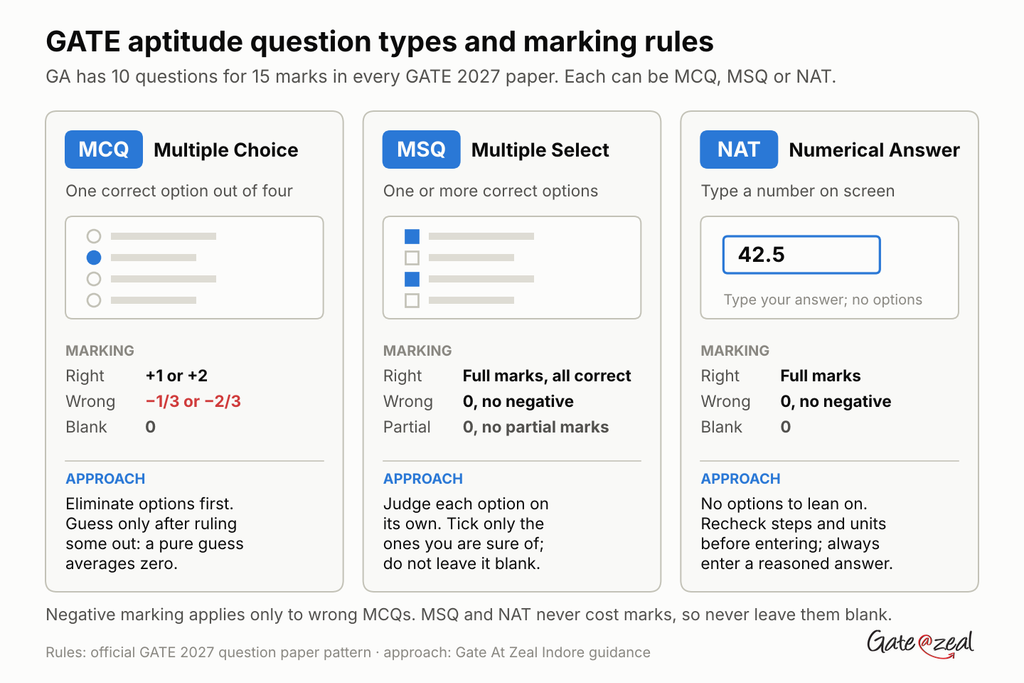
The official pattern allows MCQ, MSQ and NAT across the paper. GATE aptitude questions can appear in any of these formats, so practise all three.
By format
| Format | What it looks like | Approach |
|---|---|---|
| MCQ | Four options, one correct | Eliminate options first; guess only after ruling some out, since wrong answers cost 1/3 or 2/3 |
| MSQ | Four options, one or more correct | Check each option on its own; no partial marks, so tick only what you are sure of |
| NAT | Type a number on screen | No options to lean on; recheck the calculation and the unit before entering |
By section
Verbal questions usually test one sentence or one short passage. Read the full sentence before picking a word; the clue is often at the end.
Data interpretation questions give a chart or table and ask for a percentage, ratio or change. Read the axis labels and units first. Many wrong answers come from reading the wrong bar or row.
Numerical questions test ratios, percentages, series, logs, counting and probability. Write each step on the scribble pad; GA arithmetic is simple, but careless steps add up.
Logic and analogy questions test whether a conclusion follows. Separate what the statement says from what you assume.
Spatial questions show a shape and ask how it looks after a transformation or a fold and cut. Track one corner or mark at a time.
The three habits that save GA marks
- Read the question twice. Words like “not”, “except” and “at least” change the answer.
- Estimate before you calculate. A rough answer tells you if the exact one is plausible.
- Use the on-screen virtual calculator only for long arithmetic. The brochure says candidates must use only the on-screen calculator; for simple steps, mental maths is faster.
Daily practice plan for GATE General Aptitude
GATE general aptitude preparation works best in small daily doses. Thirty to forty-five minutes a day, every day, beats a long weekend session.
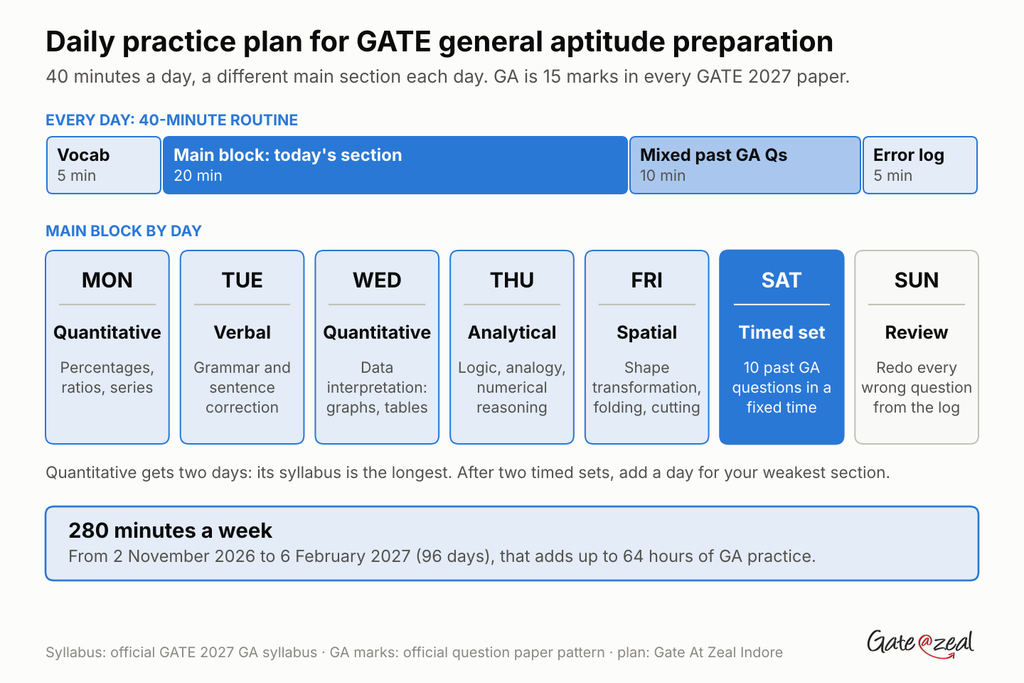
A 40-minute daily GA routine
| Minutes | Activity |
|---|---|
| 0 to 5 | Vocabulary: review yesterday’s words, add five new ones in context |
| 5 to 25 | Main block: today’s section (see weekly rotation below) |
| 25 to 35 | Mixed set: three or four past GATE GA questions from any section |
| 35 to 40 | Error log: write down each mistake and its cause |
Weekly rotation
| Day | Main block |
|---|---|
| Monday | Quantitative: percentages, ratios, series |
| Tuesday | Verbal: grammar and sentence correction |
| Wednesday | Quantitative: data interpretation |
| Thursday | Analytical: logic and analogy |
| Friday | Spatial: transformations, paper folding and cutting |
| Saturday | Timed GA set: 10 questions in a fixed time |
| Sunday | Review the week’s error log; redo every question you got wrong |
Quantitative gets two days because its syllabus is the longest. Adjust the rotation after your first two timed sets: give an extra day to whichever section loses you the most marks.
When to fit GA into your day
- As a warm-up before your main subject study, when you want an easy start.
- As a switch in the evening, when your mind is tired of heavy subjects.
Our how to prepare for GATE in 3 months guide places a 45-minute GA block in the evening of its daily timetable. Pick one slot and keep it fixed; the habit matters more than the hour.
GA plan from November to the GATE 2027 exam
The GATE 2027 exam runs on 6, 7, 13, 14, 20 and 21 February 2027, per the official important dates page. The paper-wise schedule is not out yet, so plan for 6 February.
| Period | GA goal | What to do |
|---|---|---|
| November (weeks 1 to 4) | Cover the whole GA syllabus once | Daily 40-minute routine; past GA questions section by section; first timed GA set in week 2 |
| December (weeks 5 to 8) | Build speed and accuracy | Daily routine; one timed GA set a week; GA inside every full mock |
| January | Make GA automatic | Shorter daily sets (20 to 30 minutes); GA inside two full mocks a week; error-log revision |
| Last 5 days | Stay sharp, no new topics | One short timed GA set a day; vocabulary list; rest |
Targets to aim for
There is no official target for GA. A practical self-check, as suggested by Gate At Zeal Indore:
- By end of November: you can attempt every GA section without skipping any type.
- By end of December: your timed GA sets finish inside your planned time box.
- By mid-January: your GA mistakes in mocks come down to one or two per paper, and you know which section they come from.
If you are short on time
Even 20 minutes a day of GA, kept up from now to the exam, adds up to more than 30 hours of practice. If you can only add one thing to a tight plan, this is the one with the most predictable return.
How to use past GATE GA questions
Past GA questions are the best practice material you can get, and they cost nothing. The official GATE 2027 download page offers a bulk download of question papers from 2007 to 2026, and year-wise papers with official answer keys from 2021 to 2026.
A big advantage: GA is common
Because GA is common to all papers, the GA section of any branch’s past paper is useful practice for you. A CS aspirant can practise GA from ME, EC or CE papers of the same year, and the other way round. That gives you far more GA questions than your own branch alone. Check the answer key of that same paper for the GA answers.
Three ways to use them
| Stage | Method |
|---|---|
| Learning a GA section | Collect past questions of that type (for example, all spatial questions) and solve them together |
| Weekly timed set | Take the 10 GA questions of one past paper, timed, in one sitting |
| Revision | Redo only the questions you got wrong or solved slowly |
Check against the syllabus
The GATE 2027 syllabi were revised, per the official site. Before relying on an old GA question, check that its topic is in the GATE 2027 GA syllabus above. For example, spatial aptitude and data interpretation topics are listed explicitly; practise those types from past papers.
Our guide on GATE previous year question papers explains how to download, solve and self-score with official keys.
Exam-day GA strategy
Give GA a fixed time box
The paper is 3 hours for 65 questions. GA is 10 of them, with five 1-mark and five 2-mark questions by the official numbers. Decide in your mocks how long you will spend on GA and keep to it. Gate At Zeal Indore suggests starting with a 15 to 20 minute box and adjusting it from your own mock timings. If a GA question is taking too long, mark it and move on.
First or last?
| GA first | GA last |
|---|---|
| Easy start; builds confidence | Spend fresh energy on the 85 subject marks |
| Risk: spending too long on one puzzle | Risk: rushing GA in the final minutes |
Both work. What matters is choosing one in December, practising it in every mock, and using the same order on exam day.
Use the marking rules
- NAT and MSQ: no negative marks. If you have a reasoned answer, enter it.
- MSQ: no partial marks. Select only the options you are sure of.
- MCQ: wrong answers cost 1/3 or 2/3 of a mark. Eliminate before you guess.
Calculator and scribble pad
The GATE 2027 brochure says a virtual scientific calculator will be on the screen, and candidates must use only that. A scribble pad is provided for rough work. Practise GA with an on-screen calculator in mocks so you are not slowed down on the day.
Before you enter
Carry the printed admit card and the original valid photo ID used in your application. Mobile phones, watches and calculators are prohibited in the hall. Our guide on the GATE 2027 admit card date covers the exam-day rules in full.
Mistakes to avoid in GATE general aptitude preparation
- Leaving GA for the last week. GA improves with steady practice, not cramming.
- Calling GA “easy” and skipping practice. The questions are simple, but careless errors are common without a routine.
- Practising only your favourite section. Spatial aptitude and data interpretation are where untrained students lose time.
- Reading the chart, not the axis. In data interpretation, check units, scale and labels before calculating.
- Using the calculator for everything. Mental maths is faster for simple steps; save the on-screen calculator for long arithmetic.
- Guessing MCQs blindly. Wrong MCQs cost 1/3 or 2/3 of a mark. Eliminate first.
- Leaving NAT or MSQ blank. They carry no negative marks.
- Not timing GA in mocks. Without a time box, GA can quietly eat into subject time.
- Ignoring the revised syllabus. Practise from the official GATE 2027 GA syllabus, not old topic lists.
- No error log. Repeated GA mistakes follow patterns; you can only fix a pattern you have written down.
Frequently asked questions
How many marks is General Aptitude in GATE 2027?
General Aptitude carries 15 of the 100 marks in every GATE 2027 paper, through 10 questions, per the official question paper pattern.
What is the GATE 2027 General Aptitude syllabus?
The official GATE 2027 GA syllabus has four sections: Verbal Aptitude, Quantitative Aptitude, Analytical Aptitude and Spatial Aptitude. It covers grammar and vocabulary, data interpretation and numerical computation, logic and analogy, and transformation of shapes and paper folding.
Is GA the same for all GATE papers?
Yes. The official page says General Aptitude is common for all papers and carries 15 marks.
Is there negative marking in GATE GA questions?
The same rules apply as in the rest of the paper: a wrong 1-mark MCQ costs 1/3 mark and a wrong 2-mark MCQ costs 2/3 mark. There is no negative marking for MSQ or NAT, and no partial marking in MSQ.
How should I start GATE general aptitude preparation?
Read the official GA syllabus, then practise 30 to 45 minutes every day, rotating the four sections, using past GATE GA questions. Add one timed GA set a week and keep an error log.
Can I use GA questions from other branches’ past papers?
Yes. GA is common to all papers, so the GA section of any branch’s past GATE paper is useful practice, with its answer key on the official download page.